Showing posts with label Electoral Strategies. Show all posts

Sunday, April 27, 2014

#162 April 27,2014- Education as a Rallying Point


Class, Money, Education 
and Voting. . .
America has long been portrayed as a land of freedom and opportunity.  This is one of the reasons why we have attracted immigrants from so many places throughout our history.  Our high standard of living, and our relatively open society have been a magnet that has drawn people from all parts of the world.  Even in challenging economic times America has been a preferred destination for people struggling to survive in other places.  This has been true through history, and continues even into current times. 

At the same time, those who look realistically and carefully at our history, as well as our current situation, recognize that America isn't a perfect place.  Those who portray America as an exceptional place purely on the basis of our economic and political systems, ignore the realities that exist here.  America has benefited from a combination of many different things to achieve our status in the world.  Some  are physical like our geography, isolated from the conflicts of Europe, Africa and Asia by ocean barriers and distance, our natural resources, and the huge area our nation occupies.  Others are the result of events and actions around the world that allowed our nation to grow and mature with minimal interference from other world powers.  We have been very fortunate as a nation and our growth into a superpower has not been achieved purely by our own “virtues.”  A legacy that includes brutal oppression of those who disagree with the wealthy elite who control our nation. 


The bloody labor dispute of a hundred years ago continues to reverberate in contemporary political discourse.
By The New Yorker

Our history has been a constant struggle between the ideals that our nation is built on, and the reality that the people who hold power in America create for themselves.  While we would like to imagine that our the United States has avoided the inequities and injustices that prompted many of our citizens to immigrate to America, the reality is that our nation has fallen short of the vision that we hold so dearly.  We have seen different groups fight for a share of the "American Dream" and their battles have moved our nation closer to achieving our goals of "Liberty and Justice for All."  Yet, there is always a pushback from those who have acquired wealth and status using the existing social, political and economic systems that serve to benefit their interests. 

These cycles where we advance Progressive ideals and then see  Conservative efforts to return our society to its previous status have been a part of our history and the largest conflicts have a visible impact on our nation.  We are currently involved in a time period of historical implications.  The changes in attitudes, legislation and policies that were made during the 1960's and 1970's are being undone now, in the 2010's.  Some of the most noticeable are the changes in electoral policies, attacks on the regulatory powers of our government, and the undoing of important Civil Rights legislation.  Those who have significant power and wealth are fighting hard to maintain their status as the demographics and opinions of our nation shift. 

Their efforts are designed not only to defend their status, but to eliminate the potential for any significant change to occur in the immediate future.  The efforts are many, and impact almost all areas of our society, but there are some higher profile and more intense attempts that are easily observed.  The efforts to implement restrictive Voter ID laws that will give Conservatives a political advantage which can be used effectively to protect special interests.  Another example is the effort to destroy the power of labor by eliminating the ability of workers to organize effectively.  A third example is the effort to privatize many important services that have been provided by the public sector. 


The end result of these efforts is a society that caters to the needs of a smaller number of powerful citizens.  The impacts of these policies that began being implemented in the 1980's are being felt right now.  They are observable on a larger, societal scale.

After three decades of slow growth, median income in the U.S. trails that of Canada. Poor Americans now make less than the poor in several other...
The New York Times|By David Leonhardt and Kevin Quealy

A new study by researchers from Princeton and Northwestern Universities finds that America's government policies reflect the wishes of the rich and of powerful interest groups, rather than the wishes of the majority of citizens.
Gawker|By Hamilton Nolan

They also have an impact on a personal level that affects a huge number of Americans.  Whether it influences our personal wealth, our health, our safety, or our future, the efforts to manipulate public thinking are catastrophic for anyone who isn't in the top percent of earners in America.

The connection has been "confirmed by many different studies by different investigators over different time periods."
Bill Moyers

They don't like paying taxes, and that's all that matters.
Mother Jones


New AFL-CIO report finds executive pay continues its upward trajectory as middle class wages remain stagnant
america.aljazeera.com

The obvious questions are these, if we live in a democracy why doesn't the majority vote and act in ways that will promote their own interests?  How can a small number of influential people (even with huge amounts of wealth) control a much larger number of people in a place where freedom and equality are supposed to be held in such esteem?


The simple answer is that we idealize the wealthy and strive to achieve the same status as they hold.  We often do this at our own expense, or at the expense of others who should be our allies in the fight for social justice.  We believe the hype about the "job-creators" and we allow ourselves to be mislead by media and advertising that promote an agenda that directly opposes our own interests.    

None of these money-making methods are productive, or praiseworthy, or suggestive of a meritocracy. Perhaps demeritocracy is more apt.
Truthout

A California firm on behalf of an undisclosed client has bought nearly $2 million worth of air time from Sept. 1 to Nov. 3 in four Wisconsin markets.
Milwaukee Journal Sentinel|By Daniel Bice

Another thing that has allowed a minority of citizens to dominate the majority socially, politically and economically is the lack of a unifying force that citizens could rally around.  All of our efforts to advance the values of social justice have been focused on different subgroups or interests.  Labor has fought for the goals of labor and different demographic groups have fought to promote their own interests.  This has allowed for the strategy of "divide and conquer" to be used effectively.   There has rarely been a concerted effort by many groups to unify around the ideals of "Liberty and Justice for All."  We have come close at times, for example under the leadership of Dr. King during the Civil Rights movement, but eventually the movements fragment under the strain of internal and external pressure. 

The Wisconsin Uprising of 2011 had the potential to be an effort that could combine many different interests.  Yet, as we move further through time we see how the difficulty of incorporating multiple interests along with the constant attacks from our opponents weakens the power of a movement based on combating societal injustice. 


The Uprising needs to find a unifying issue that can take the effort to the next level and propel us to further action.  Education could be that issue.  It is important to labor, impacts every demographic group, and is an issue that lies at the very heart of the social justice movement.    

To truly improve education in Milwaukee, we must start with the assumption that poor children are no less deserving of a quality education than rich children. As such, the schools that privileged suburban parents demand for their children should be the yardstick we use to measure the adequacy of edu…
epi.org

In order to realize the full potential of education we need to combat the message of education "reformers" and educate the public about the realities of what is needed to fully accomplish the goals of equitable and inclusive public education.  This means calling out the "reformers" and providing a real view of just what is being done to our public education system in the name of equity and opportunity. 

On Sunday, March 23, 2014 in a speech at Riverside Church in Manhattan, New York City Mayor Bill de Blasio, faced with declining public opinion poll numbers, made nice to charter school companies and their wealthy...
portside.org

In 1848, Sam Brannan ran up and down the streets of San Francisco yelling, ”Gold! There’s gold in the American River!” Brannan had no intention to dig for gold himself, of course. Just before he ma...
davidsudmeier.com 

NEW YORK (AP) — "Just Do It" has been a familiar Nike slogan for years, but some parents are wondering what it was doing on some of New York's Common Core standardized English tests.
MSN

The health care law may be Republicans’ favorite weapon against Democrats, but the Common Core is also roiling the party and shaping the establishment-versus-grass-roots divide.
The New York Times|By Jonathan Martin

This means that educators need to step up and become active in promoting our profession and making education an issue that can unify the different aspects of the Progressive movement.  It has been a very difficult past 3 years, but educators are resilient and our cause is just.   

The effects of reform on the teaching profession.
Washington Post

The end of collective bargaining.
m.lacrossetribune.com|By Lee Enterprises

The Good, The Bad and
The Ugly. . .

The Good . . . Conservatives and others who oppose virtually everything that President Obama has done are continuing their crusade against the ACA.  They will find some way to spin this in a negative way, but I fail to see how providing ways for more people to access healthcare is bad for our nation.

About half of this is through the exchanges. The rest is via Medicaid and employer plans.
Mother Jones

A great way to send a message, and to support public schools.  Could something like this happen in Madison?

A grassroots effort to support schools grows into a sizable donation.
wqow.com|By Kristen Shill

The Bad . . .  Nothing that we haven't heard before, or that is shocking for people who have been paying attention.  The questions remain, what do WE do to make changes?

A nationwide study of racial disparity has been released.
m.policymic.com|By PolicyMic

The Ugly . . . With all of the publicity about mass shootings and gun violence in general, how is it that nothing seems to improve?  The answer lies in a couple of places, our nation's inability to combat a powerful gun lobby and the NRA is one.  The other is our reluctance to address the mental health needs of so many in our population.  Not everyone who commits a crime with a gun is mentally ill, however, an improvement in our treatment and support of those struggling with these illnesses could go a long way in creating a safer society for everyone. 


Welcome to America, the land of blue jeans, rock & roll, and sporadic meaningless mass murder.
Mother Jones
Medicaid expansion would mean millions more would get mental health care coverage.
Washington Post

Sunday, October 28, 2012

Issue #85 October 28, 2012- Vote!!!


What This Is…
Issue #85- October 28, 2012
In this issue: Vote 

Get Out and Vote…
Early voting started this past week here in Wisconsin and we are less than 10 days away from Election Day.  Elections always matter, but this year's election has taken on extra significance for a variety of reasons.  The rancor of the discourse has amped up the interest as well.  Here in Wisconsin we are not only interested in the national races, but also in the local races that will determine control of our state senate.  A GOP majority in the senate would allow Governor Walker to resume his unobstructed attacks on public services and public employees.

I would guess that for most citizens, November 6th will bring a sense of relief.  Relief from the constant barrage of advertising and the vicious political dialogue that has poisoned our airwaves and media outlets.  Relief from the robocalls and polling.  A chance to return to "Normalcy" and ignore politics for at least a year or two.  Even those of us who have been "awakened" politically feel worn down and in many ways discouraged by our nation's inability to engage in meaningful, polite discourse over the issues of the day.

These feelings of exhaustion and frustration lend themselves to a mood of pessimism.  Pessimism fueled by the ongoing cacophony of attack ads and angry rhetoric that fills our airwaves, mailboxes and newsfeeds.  Citizens of all political persuasions are expressing dissatisfaction with the process and the results of recent campaigns.  We face widespread concern about the validity of our electoral process as well. 

The result is a curious blend of activism and apathy.  On one hand there are a significant number of people who are more involved now than they have ever been, while at the same time a significant number of people are continuing to "opt out" of the voting process.  Look at the turnout in the June recall elections in Wisconsin.  With all the hype and significant reasons for involvement turnout still only reached around the 60% mark.  While everyone trumpeted the record number of voters as evidence of the intense interest we cant forget that 40% of the population still didn't make it to the polls.

There are many reasons for the continuing lack of voter participation in elections at all levels, but in the end there really is no reason that any eligible voter should fail to cast a ballot.  With early voting, absentee ballots mailed to your home, free taxi rides on election day and numerous other "Get Out the Vote" efforts we should see close to 100% participation by citizens fulfilling their most basic of duties. 

Each of us has a responsibility to encourage, cajole and motivate those around us to get to the polls and cast a ballot on, or before November 6th.


            Why I (Usually) Vote Democrat, and Why I Will Do So Again…
I claim to be an independent progressive when it comes to identifying my political allegiances.  However, it sure seems like this means that most of my votes have been given to Democrats.  This excludes a brief relationship that I had with the Republican party in the late 1970's and early 1980's when I was drawn to the color blue that was used to show states that had voted Republican.  I guess it was to contrast with the gray used for Democrats in a time when some viewers still had black and white TV's.  As a Civil War buff I couldn't find a way to support the colors of the Confederacy.  I was also around 10 so my political views were not fully developed either. 

I'm not alone in this and recent elections have only cemented the party affiliations that many of us have.  This is true whether we fully support the party we cast a vote for, or even if we have significant problems with the platforms they put forward.  In a two party system like the one in America today, there is little wiggle room for the independent voter.  It feels to many like we are stuck voting for a candidate because casting a ballot for an independent only serves to lend support to a candidate we oppose. 

I hear dissatisfaction coming from both camps, even though the spokespeople of the different parties do their best to mask dissension and spin any internal conflicts to limit the appearance of disagreement in the party ranks.  Since I am neither a conservative, nor a Republican I won't speak to their squabbles over just how far to the right they would like Mitt Romney/Paul Ryan to veer.  My concern is that the issues that many here in Wisconsin have with President Obama may end up with people casting ballots for negative reasons instead of choosing the candidate that most closely represents their interests while still having a reasonable chance of winning. 

The issues that Wisconsin's progressives have are many and legitimate.  We wonder where President Obama was during our struggles with Governor Walker and why he provided so little support for our efforts to advance causes that he claimed to have such passion for in his campaign of 2008.  We look at his record on education and the fact that worker's rights have continued to erode under his watch.  Many feel that he hasn't gone far enough in speaking out to represent those who supported his candidacy 4 years ago.  In some ways it seemed like our resistance in Wisconsin fueled a change in Obama's words and actions and provided a spark that strengthened his resolve and put him on a path towards becoming the president we hoped to have when we elected him.

Yet, it seems like it may be too little and too late for some voters.  Their dissatisfaction leads them to think seriously about casting a ballot for a 3rd party candidate.  They do this with the knowledge that a vote for anyone but Obama is a vote for Romney.  They do this with a clear motivation and a resolve to make a statement about their perceived lack of choice in this election.  I understand their feelings and opinions and wholeheartedly support their right to cast a ballot as they choose.  No one should be "guilted" or coerced into voting for a candidate. 

I do hope that people consider all their options and cast their vote thoughtfully and with care.  We saw the results of a divided and disconnected electorate in 2010 and are paying a heavy price for those results.  When you compare the election results of 2008 and 2010 you see a huge number of voters who chose to sit out the most recent election.  These voters silenced themselves and now face challenges much more significant as a result. Wisconsin provides an excellent example of a state where this occurred.

On a very basic level it is true that we should cast our votes without thought about strategy or political consequences.  I know that whenever I vote my first criterion is the candidates stance on issues that I feel are important.  Political repercussions are farther down on my list, but certainly have come into play at times.  Unfortunately, there have been elections where I felt I was casting a ballot for the "lesser of two evils".  Luckily for me, the election of 2012 isn't one of those.

The candidates on their ticket aren't perfect, but then no candidate ever is.  In my opinion there are many reasons to get out and vote Democrat in this election.  The most important of these reasons isn't based on any specific position on a single issue.  Based on recent experiences at the local and state level, along with observations of what has happened nationally it appears that the Democratic party offers the best chance for more voices to be heard.  Here in Wisconsin we have seen the GOP use their power to stifle opinion and force legislation and policy through the system without allowing for debate or discussion to occur.    

I know that within any demographic there is a wide range of opinions.  Our nation's system of representative democracy should mean that individual voices will be blended into policy that (if our representatives do their jobs) will trend in the direction that benefits our society.  It may not happen quickly and there will be setbacks, but by allowing for public input and debate between representatives a common interest can often be reached.  Even when we fall short of our aspirations for our nation we still can see trends towards something "better".  If we don't then it is our obligation as citizens to rise up and make our voices heard. 

The key to the process is allowing multiple voices to be heard and for all parties to approach the problem solving process in an open and rational manner that looks beyond individual needs.  Our representatives need to defend the interests of those they represent, but not at the cost of undermining the system or by excluding other opinions from the debate.  We see the GOP trying to silence the voices of a majority of citizens and advance the goals of a minority in many ways.

Voter suppression is one obvious example of the Republican effort to limit participation in the process.  The consequences for our democracy should be obvious and GOP control of any part of our government (local, state, national) will help them in their efforts to seize control of our nation.  


Voter suppression doesn't have to be done through legislation or public policy.  In fact, when done through the workplace or on a personal level it may even have a more damaging effect.  Intimidation and threats are one way to get employees to vote against their own interests.  


Wisconsinites have seen firsthand what happens when this current brand of Republican does when they have full control of the government.  Public debate is silenced and/or ignored and radical policy is implemented without due process.  Who can forget the image of Representative Barca trying to make a point while the role is called to push Act 10 ahead. 

On a all levels our political discourse and culture has changed drastically for the worse.  The rules of our legislatures and political entities are designed to facilitate discussion, but can be manipulated and used to achieve just the opposite.  We have seen the GOP use tactics to stall initiatives that may have helped numerous citizens.   


These types of actions are done, not for positive reasons, but rather to undermine the opposition.  We know that politics is all about public perception and "spin", but to bring our government to a standstill isn't in anyone's best interest.  I should take a moment to address the obvious argument from the conservative point of view, isn't that exactly what the Wisconsin 14 did last spring?  I would argue that the Democrat senators from Wisconsin left the state because due process and legislative procedures were not being followed.  If the GOP controlled legislature in Wisconsin had shown any sign that reasonable debate was going to occur I don't know that the senators would have gone to Illinois.  We won't ever know, but they were facing an unreasonable situation and their options were limited.  There is a difference between making a stand on an issue (one that could result in significant consequences for them) and simple obstructionism for political purposes. 

The fact that the economic policies that these GOP legislators are advancing are not in the best interests of most Americans makes their actions more troubling.  While attacking President Obama's ideas the Republicans are offering an agenda that weakens our nation's economy and harms many citizens opportunities to succeed.  


This is just as true in Wisconsin as it is around the nation.


Dividing the population isn't only done economically.  It is difficult to see how the GOP's policies benefit citizens who are not white and male.  I am hesitant to accuse anyone of racism, sexism or other prejudice.  It is difficult to know another person's true thinking or the reasons for their actions and accusations are often thrown around too quickly.  However, it is just as difficult see how the rhetoric or policies advanced by conservatives benefits groups outside what they consider "mainstream America".       


The divide and conquer approach has been used effectively by the GOP in the arenas of education and labor relations.  In both places we see conservatives using fear and intimidation, combined with some envy and misinformation to pit groups that should be working together against one another.  The result is bad policy that is supported by people who thought they were getting something different.    


This is a great SNL skit that puts our economic and labor issues in a different light.


In the end, the question remains, who are our representatives representing?  It certainly appears that many of them are not representing their constituents, but rather their large money donors.   


The public struggles to find accurate information that isn't politically motivated.  Any action by any political figure or public event is presented in ways to make a specific candidate or agenda look good.  This is politics as usual, but it is politics as usual on an inflated scale.  The rhetoric around the attacks in Libya provide an example of pain and suffering manipulated for political ends.    


We face a critical election that will have significant consequences.  Our next president will, in all likelihood, make multiple appointments to the Supreme Court.  We face some difficult challenges in foreign policy.  Domestically, we need to address our economic troubles and get our nation moving ahead.  All of these issues demand strong leadership on all sides, statespeople instead of demagogues. 

The progressive philosophy is one that looks for the greater good and emphasizes collective action.  Now is not the time for us to abandon our beliefs or to give in to more aggressive political agendas that claim to be the quickest path to success.  


What started in Wisconsin has been spreading across the nation.  We need to cast our ballots in ways that will allow the movement to continue to grow.  By voting Democrat we won't necessarily get someone who represents our specific interests, but we will allow for debate and discussion to continue.  


There are other, more influential, people who think the same as I do.


In the end, no matter what your stand on politics is, we need to see huge turnouts in the November 6th election.  In Wisconsin it is even more important for progressives to turn out to make sure that the senate retains its Democrat majority.  Every vote counts, make sure to use yours.

Saturday, April 7, 2012

Issue #57 April 7, 2012- Politics, Defending Unions, Spend Carefully and More


What This Is…
Issue #57- April 7, 2012
In this issue: Political News, Unions Are Necessary, It Isn't Working for Wisconsin, Spend Your Money Wisely

Political News…
Elections as Political Strategy
The Progressive Movement in Wisconsin has chosen to use the electoral process as one of our main vehicles for fighting the right's attacks on our values.  A tremendous amount of energy and effort has gone into the recall effort and towards supporting progressive candidates at the local level.  While this is a sound strategy in many ways, it also is a risky and often frustrating way of enacting change.  However, if we truly believe in the ideals of democracy we must be prepared to take our message to the citizens.


Elections can't be our only method of resistance, but they make an excellent first line of defense.  We know that we face an uphill battle and there are many obstacles to running successful campaigns against GOP candidates. 

Propaganda and Political Extremism: The GOP has mastered the art of political advertising/propaganda.  The idea of taking a few simple themes, and hammering on them until voters associate a parties agenda with their own interests is key to Republican successes in recent elections.  By making themselves out to be defenders of freedom, justice and the "American Way" the GOP has convinced many voters to cast ballots in ways that defeat their own interests.  This aggressive and manipulative strategy has been employed by many groups throughout our history, but modern media outlets allow for advertising and other forms of propaganda to have a huge impact on elections.  The attack on "Obamacare" by the right is one example of the tremendous amount of influence propaganda can have on an issue.    


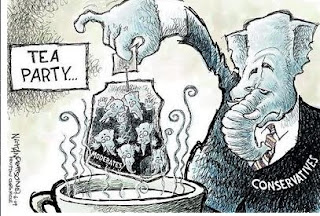
What is flying under the radar of mainstream media and general public attention is the fact that the agenda espoused by Walker and other extremists is exactly that, EXTREME.  For the past 50+ years there has been an ongoing battle in the Republican Party between moderates and conservatives for control over the party platform.  The Republican Party of 2012 is much different than the party that existed a relatively short time ago.  Clifton White, a conservative Republican leader during the 1950's and 60's, used tactics borrowed from the Communist Party to promote a radical conservative philosophy.  In a book by Geoffrey Kabaservice, Rule to Ruin, he states that Clifton, "Saw in their (Communist's) example the methods by which a small, disciplined minority, uninhibited by bourgeois scruples over fair play or tradition or truth, could defeat a majority and bend an organization to its will."  Sounds a lot like our modern day Tea Party strategies, and we can find significant parallels between this philosophy and Scott Walker's strategies. 

Progressives need to take a page from the GOP handbook and use the same political strategy (minus the illegal, immoral and unethical aspects) to emphasize the fact that what is being pushed by Walker and his supporters is not what is valued by mainstream Americans.  The extremist GOP agenda isn't good for our society in any way (political, economic or cultural).  In a response to the conservative efforts to seize the GOP during the 50's a group called the Ripon Society wrote an open letter called the "Call to Excellence".  This letter stated,      "We must show our world that our emotion can be aroused by a purpose more noble and a challenge more universal than the cries of an irresponsible extremism…We must learn to be as excited about openmindedness as we once were about final answers." 

This is a challenge for progressives and moderates because as Doug Bailey, one of the founding members of the Ripon Society, stated,  "Moderates are moderates.  Raising the sword of moderation and marching down a street is a contradiction in terms….With people who feel passionately about something and are certain that they are right, it's easier to get them to organize and march and do the things necessary to be sure that their position prevails-because they have no doubt.  On the other hand, if you're moderate, it basically means you have some doubts….You're not as certain of your beliefs, and they may not dominate every moment of your existence.  And therefore it's not likely that you're going to make the commitment of time, energy, money, resources , and passion to try to turn your beliefs into reality."

We must make the differences clear and make citizens realize that their moderate views are viewed as extreme by the extremists on the far right.  The conservative movement as represented by Walker has no respect for the moderate view.  This is why we see the normally quiet and politically dormant middle class of Wisconsin rising up and protesting, petitioning and actively resisting the Walker agenda. 

We must counter the message that resistance to Walker's "reforms" is radical by sharing the facts about what is really happening.  It is clear that the conservatives are putting a great amount of effort into "radicalizing" the protests and recalls.  By making activists seem like they are on the fringe of our society the conservatives hope to make their actions seem moderate and rational.  This is why it is so important to share information with fellow citizens and to speak out against what is happening here in Wisconsin.  The recalls are not a radical movement, they are a strong and positive response to the actions of the GOP in our state.  

Media Bias: The mainstream media is failing in their duty to accurately report the facts surrounding events here in Wisconsin (and around the nation).  It is the duty of the members of the media to report events in as unbiased a way as possible and to make sure that the public is informed about events that are of importance to them.  Instead of fulfilling their duties, the media here in Wisconsin has "sold out" in their effort to appear unbiased and to sell their product.  This has happened in many ways:

Misrepresenting events and not correcting the mistakes…  Remember the $7.5 million price tag for the February protests in Madison.  We were told in no uncertain terms that protesters had destroyed the beauty of the Capitol and were going to cost the taxpayers huge sums of money.    

(5% of this cost was to a consultant to determine what needed to be done)

Writing editorials and saying they're news…  News articles should be filled with facts and give an unbiased account of events.  Much of what fills our news media's papers/broadcasts/etc. really belongs on the editorial/opinion page.  When covering a story like the political conflicts in Wisconsin, news outlets need to be very careful about their coverage.  These two articles provide excellent examples of how thin a line this can be. 


A lack of credible sources and quality reporting….  What I've found disappointing in local media coverage is the lack of facts.  For example, the local newspaper never took the opportunity to share the details of the budget repair bill, or the budget in their efforts to cover the story last year.  Instead they relied on short snippets of the legislation and quotes from individuals.  I also find it troubling that there are so few sources that are used in covering a story.  Using the Achievement Gap as an example you find local media quoting from only a small number of sources on a consistent basis.  A couple of individuals with opposing views are quoted and the media then claims unbiased reporting.  The issues we are grappling with here in Wisconsin deserve better coverage. 

Profit over substance… It is clear that the local media outlets are more interested in selling product than in really covering news.  Is this the fault of the local reporters, or is it part of a larger effort by conservatives to dominate the media to get their message heard more clearly than progressive views?  Big money has an influence in all areas of our society and our media is not immune from this. 
Campaign Funding: The amount of money spent on Wisconsin political campaigns this year will be record setting.  Scott Walker and the GOP will benefit from significant support by wealthy donors.  Unions will try and match the efforts, but the ability of unions to counter the wealthy foundations and Super PACs isn't the real issue.  What is at stake here is the trend towards eliminating the power of the individual to influence an election.  The money spent in Wisconsin will go primarily to less regulated organizations who will spend their money on negative advertising designed to scare and intimidate voters to cast a ballot against a candidate, not for a cause.  


Election Fraud: We've been told to fear the fraud and corruption that has tainted recent elections and the recall process.  Now that the huge amount fraud (4 fraudulent names and a tiny percentage of signatures thrown out) in the recall process has been exposed.  We should begin to worry about all those illegal ballots that will be cast for Democrats in the elections because Voted ID is in jeopardy.  This is a great example of GOP propaganda being used to fuel unreasonable fears that lead to unreasonable "protections" being put in place.  "Protections" that actually harm democratic values while claiming the opposite.

What should we really worry about? 


April 3rd Results
The recent elections showed us the two sides of using elections as a strategy to reclaim Wisconsin.  First, there is the inevitable concern about voter turnout.  One would think that in our politically charged atmosphere there would be a large percentage of voters participating in any election.  That only about 23% of Wisconsin voters showed up on Tuesday is troubling.  In Madison only about 28% of the registered voters cast a ballot in what was considered one of the most hotly contested school board races in recent memory


Why is this troubling?  It is scary that about 1/4 of the citizens who could cast a ballot did.  This means that a small minority of people decided who will sit as a judge, who will make vital decisions for our schools, who will make decisions about what our local governments do, etc.  While there were encouraging signs in the races for Dane County Board, the result for the school board election were mixed.  I believe that Madison citizens missed a chance to elect a new face in Michael Flores and instead went with a known entity in Burke.  I continue to be troubled by her stand on Madison Prep and other issues, but time will tell what type of board member she will be. 


Of interest to many of us was the appointment of Kaleem Caire to the board of the National Association of Charter School Authorizers.  Given all that has happened in Madison regarding the efforts to get Madison Prep off the ground it is becoming clear that the Madison Prep movement was not just about that single school.  It is difficult to believe that the Madison Prep proposal wasn't an opening volley in the effort to privatize education in Madison.  An effort that has met with generally poor results across the United States.  Now that Mary Burke is on the board, supporters of charter schools are hoping that will give enough support for privatization to occur.  Citizens of Madison need to stay informed and make sure that we protect our public schools. 


Defending Unions…
At the heart of the current battles in Wisconsin lies the fight for worker's rights and the conservative dislike of labor unions.  There are many other issues of great importance, but without the direct attack on the rights of workers we would not be seeing the high level of political upheaval that we are experiencing here. 

The reasons behind the attacks seem obvious.  There are political and economic motives for conservatives to work to destroy labor unions.  Unions are one of the last large political forces that oppose conservative candidates.  They provide the organization and money for candidates running against the GOP, primarily Democrats.  They also provide organization and support for workers trying to increase wages and benefits while improving working conditions.  Things that cut into a business' "bottom line".  With unions out of the way, and Citizens United in full effect, conservatives would have a tremendous advantage in any contested political campaigns.

Membership in private sector unions has declined over the years.  This is due to many factors, but in no small part is due to efforts by a coalition of conservative lawmakers and business leaders to make labor organizing more difficult.  With private sector unions declining it makes sense that the next target for anti-labor efforts would be the public sector unions.  Scott Walker's efforts to dismantle public sector unions is not isolated, but certainly has taken center stage in the struggle going on across the country.       

These attacks have been justified by conservatives as necessary for the economic health of our governments at all levels.  We've been told that legislation like Wisconsin's Act 10 (the budget repair bill) save money, give flexibility to local governments and that they protect the rights of workers to choose whether to unionize or not.  Over the next few months we will hear examples of the supposed effectiveness of the "reforms" that Walker and the Wisconsin GOP pushed into law.  We will here all about the supposed evils that public sector unions have imposed on individuals and on our society as a whole.  All this will be done while at the same time saying that it isn't the individuals who are the problem, it's the unions (Ever hear anyone say, "I like teachers, I don't like teacher's unions")

Anti-union forces have found their ultimate quote in the letter written by FDR to  Luther C. Steward, President of the National Federation of Federal Employees, in August 16, 1937.  In this letter he states,  "The process of collective bargaining, as usually understood, cannot be transplanted into the public service…"  Their argument is that public employees should be treated separately from private employees and are not entitled to the same rights and privileges.

Over the next couple of weeks I intend to explore some of the reasons public sector employees need to have the right to organize and enjoy the protections offered by unions.  However, as I began thinking about how to share my ideas I began to realize that this separation of public and private sector workers is to some significant degree an artificial one.  A division created specifically to separate workers and to create dissention between different groups who have essentially the same goals and objectives at heart. 

I recognize that there are many who would disagree with me and say that the two types of employment are very different.  This is primarily due to the difference in management.  The argument that I usually hear regarding the differences is one heavily influenced by conservative ideology.  This argument follows the thinking that too much government is bad and that private industry is more productive and efficient in utilizing resources of any type (including human capital).  Because public employees get their money from public funds which are controlled by elected officials this somehow gives the employees unfair leverage and control over their working conditions and benefits.   


I don't pretend to be an economist or any expert in this field.  However, after much reading and practical experience in private and public occupations I fail to see the validity in this argument.  What I do see is a concerted effort to paint public employees as less than their private sector counterparts.  We are portrayed as lazy, unproductive and protected by unions no matter how incompetent we are.  Much is made of our high salaries and great benefits, things that private sector workers are told are unreasonable.  We perpetually hear about how public sector workers are finally feeling what private sector employees have faced for a long time. 

With the downturn in the economy the conservative faction of the GOP saw an opportunity to drive the wedge between workers even deeper.  Private sector employees were hurt financially by the poor economy while public workers maintained their level of financial stability.  While this may be true, what can't be ignored is the growing separation between the wealthy and the rest of Americans.  Our wealthiest citizens have not been adversely affected by the struggling economy, on the contrary they have benefited greatly.  Separating workers into competing camps profits the wealthy.  If they can break the public unions then their domination of the employer/employee relationship will be nearly complete.

If we follow the conservative logic a reasonable question becomes, why should public employees be allowed to unionize?  In their opinion the answer is clear, public employees don't need, nor should they be allowed to unionize.  However, my response to that question is different.  I would state that not only should public employees be allowed to unionize, but all employees should enjoy the benefits that organizing a union can provide.  If all workers enjoyed the benefits that unionized workers have battled for we would see a better standard of living, an improved economy and a more equal society.  Isn't that a series of goals that any political party should be supportive of?

If conservatives are against public sector unions, does that mean that they support private sector labor organizations?  The short answer is a resounding, NO, the current strand of conservatism being pushed by GOP leaders like Walker is very anti-labor.  Most union members, public or private, see that if Wisconsin's public unions are defeated then we will see more extreme anti-worker legislation here in the future.  Right-to Work and other measures will become the law of the land and all employees will face a labor market controlled by management.

While the anti-labor agenda is not new to our political landscape (take the late 1800's for example) the efforts to legislate the labor-management relationship have intensified recently.  This has created an atmosphere of intense conflict, and which points us towards a future where labor-management clashes will be more extreme because of a lack of an impartial and fair dispute resolution mechanism.  Walker's agenda ends a period of relative labor peace and replaces a system that has been gradually built over time.  A system that resulted from negotiations and compromise between labor and management.  A system that is widely accepted and supported by mainstream America.  Dwight Eisenhower stated this sentiment when he said,  "Should any political party attempt to abolish social security and eliminate labor laws and farm programs, you would not hear of that party again in our political history.  There is a tiny splinter group, of course, that believes that you can do these things, but their number is negligible and they are stupid."

Wisconsin is a state with a long tradition of active engagement in the struggle for worker's rights.  The people here "get it" and that is one of the reasons that we have seen such a strong response to the Walker-led attacks on unions.  Public and private sector union members along with non-unionized citizens stood together at the capital and exercised their 1st Amendment rights by signing recall petitions in astounding numbers.  This battle is not just about unions, but unions play a huge role in the resistance. 

Not only should public workers have the right to organize themselves in unions, but the unions they belong to should have the same rights as those enjoyed by the private sector.  Looking at the letter that FDR wrote we can see that there is a context which conservatives fail to give when using the quoted portion of the letter.
See below the full text of FDR's letter.  Note that he is supportive of public sector unions, but sees some limitations.  Most importantly he views "militant action" as something that public workers should not engage in.  In Wisconsin strikes by public workers are already illegal.  

My dear Mr. Steward:
As I am unable to accept your kind invitation to be present on the occasion of the Twentieth Jubilee Convention of the National Federation of Federal Employees, I am taking this method of sending greetings and a message.

Reading your letter of July 14, 1937, I was especially interested in the timeliness of your remark that the manner in which the activities of your organization have been carried on during the past two decades "has been in complete consonance with the best traditions of public employee relationships." Organizations of Government employees have a logical place in Government affairs.

The desire of Government employees for fair and adequate pay, reasonable hours of work, safe and suitable working conditions, development of opportunities for advancement, facilities for fair and impartial consideration and review of grievances, and other objectives of a proper employee relations policy, is basically no different from that of employees in private industry. Organization on their part to present their views on such matters is both natural and logical, but meticulous attention should be paid to the special relationships and obligations of public servants to the public itself and to the Government.

All Government employees should realize that the process of collective bargaining, as usually understood, cannot be transplanted into the public service. It has its distinct and insurmountable limitations when applied to public personnel management. The very nature and purposes of Government make it impossible for administrative officials to represent fully or to bind the employer in mutual discussions with Government employee organizations. The employer is the whole people, who speak by means of laws enacted by their representatives in Congress. Accordingly, administrative officials and employees alike are governed and guided, and in many instances restricted, by laws which establish policies, procedures, or rules in personnel matters.

Particularly, I want to emphasize my conviction that militant tactics have no place in the functions of any organization of Government employees. Upon employees in the Federal service rests the obligation to serve the whole people, whose interests and welfare require orderliness and continuity in the conduct of Government activities. This obligation is paramount. Since their own services have to do with the functioning of the Government, a strike of public employees manifests nothing less than an intent on their part to prevent or obstruct the operations of Government until their demands are satisfied. Such action, looking toward the paralysis of Government by those who have sworn to support it, is unthinkable and intolerable. It is, therefore, with a feeling of gratification that I have noted in the constitution of the National Federation of Federal Employees the provision that "under no circumstances shall this Federation engage in or support strikes against the United States Government."
I congratulate the National Federation of Federal Employees the twentieth anniversary of its founding and trust that the convention will, in every way, be successful.
Very sincerely yours,

While there are specific issues that are different for public workers compared to private sector workers, the fact remains that public workers need to organize to protect themselves.  The actions by Governor Walker, the Wisconsin Legislature and the Judicial System of Wisconsin have created the basis for a system that will not benefit public workers or the citizens of Wisconsin who rely on the public workers for many vital services. 

We have seen the rights of private sector workers pushed aside so that the labor market can be more "competitive" and less regulated.  At the same time real wages for workers have declined and salaries of CEO's have risen astronomically.  The GOP would have us believe that unions are the reason our economy has faltered.  Conservatives have tried to create an environment where people look down on organized laborers as being un-American.  At the same time they have done everything possible to create a management friendly environment where people are so thankful to have any job that they won't speak out against unfair practices.    


The lines are drawn and the odds are against organized labor.  However, that has been the case all through history.  Since the days of ancient Egypt when workers constructing the great pyramids organized a strike labor has fought for better conditions and fair wages.  We will continue that fight here in Wisconsin and across the United States.  This is a battle for our present, but also for the future of everyone who is not part of the wealthiest few.  It is our job to make sure that all citizens understand this whatever their job.  Public or private sector means much less than the brotherhood and sisterhood of labor.  All labor deserves and must demand respect.


It's Not Working…
With all the attention focused on unions and labor issues we can't forget that the policies of the Walker administration are not succeeding.  In other words, don't believe the hype that will be put forward in press releases and advertisements.  Not only are his economic policies failing, but other legislation passed by our GOP dominated government is clearly harmful to many Wisconsinites.


Buy Local…
Along with organizing and sharing information it is also important that every person is careful who they give their money to.  Corporations and all businesses are driven by profits and are vulnerable to the consumer.  While it may seem like a small thing, making a simple change and buying a different product is a strong statement in the battle to restore the rights of all citizens.  Companies are noticing and making changes in how they go about their business.   


This Facebook page and website has lists of products and companies that support anti-worker and other similar lobbying organizations.  Look the lists over and see where you can make a change in your purchasing habits.  Do you really want to donate your money to ALEC?