Showing posts with label Organizing for Social Justice. Show all posts

Sunday, April 14, 2013

Issue #109 April 14, 2013- Organize for Education


Organize and Activate…
"May you live in interesting times", is a phrase of unknown origin that sounds like a blessing, but is actually considered more of a curse.  Interesting times are ones of danger, uncertainty and often are unpleasant.  Compare that to times of peace and there is no doubt that most of us would prefer to experience the relative "boredom" of the latter.  During less interesting times people experience stability and go about their daily lives untroubled by upheaval and controversy of a scale beyond the immediate and common.  Of course stress and trouble are a part of these times, but not at the same level and intensity of "interesting times". 

In many ways Wisconsin had been experiencing relatively uninteresting times for the past decades in most aspects of our society.  For the most part we enjoyed stability in our social, economic and political activities.  That isn't to say that there weren't significant problems in our state, but rather that we were not generally uncomfortable with the way things were.  While it is true that we should not have been as complacent in our attitudes in many areas, Wisconsinites weren't demonstrating much in the way of significant interest in making changes in the status quo. 

All of that changed with the election of Scott Walker and the subsequent events of early 2011.  It was as though a small wound had been ripped open, exposing a much more significant injury just beneath the surface.  The elimination of collective bargaining rights for public employees was the spark that ignited a blaze of action.  Suddenly the eyes of many of us were opened to a whole host of issues as well as the potential connections that existed between groups that had previously viewed each other with, at the very least, indifference if not even some antipathy.

Public employees, quite frequently white, middle class citizens, saw just what it was like to be outsiders and disenfranchised.  They realized just how fragile our rights and privileges are when they are taken for granted and left undefended.  We also saw just how fragmented and easily "divided and conquered" our society was, as Walker and his supporters ran roughshod over issues of social justice, fairness and equal opportunity.     

Yet we also found that "interesting times", while fraught with peril on one hand, are also times of opportunity as well.  Groups and interests that had opposed each other found a common enemy in the Walker administration and its policies.  We discovered areas of common interest and unity that had existed all along, but that were ignored while we pursued our own separate interests.  While there were opportunities, there were also long standing barriers that existed.  Trust between groups has been eroded over years of slowly entrenching positions based on actions or inaction. 

An example of this is found in public education.  This is an area where many progressive interests come together.  It is also a place were all races, social classes, religions, and any other demographic distinction should find a place.  Yet, because of many different reasons, trust in the public school system has been undermined, and for many groups our public schools have become another symbol of oppression and lost opportunity.  Conservative interests have actively worked to foster the mistrust of our schools and supporters of public education haven't been able to, or done enough to, counter these actions.     

There was also a need to mobilize a base, that had relied on legal protections, bureaucratic procedures and a small number of organizational "experts" to promote our interests.  If we had a problem, there was someone who we could turn to, or a policy we could access that would help us overcome our obstacles.  Along the way we became observers and not participants in important aspects of our lives.  We didn't take personal action to defend our rights in the workplace, in economic terms, or in society as a whole. 

Now, we are seeing Scott Walker and other conservative GOP leaders stripping away the legal and procedural protections that we have come to rely on.  This has had a devastating effect on many of us.  We see a conscious effort to change the way our society operates and to put a significant amount of power in the hands of a small number of people.  There is no doubt that there is a deliberate and purposeful plan that is being implemented to gain control of our society from a political and economic standpoint. 

One example of this is the efforts to privatize our public schools.  Our public schools aren't perfect, but they are the institution that is most likely to give all students an opportunity to learn.  Our schools are accountable to the public in a way that privatized voucher schools are not, and never will be.  Our public schools are also a place that is legally bound to attempt to meet the needs of every child, no matter what their needs may be.  Yet, Walker has articulated his plan to destroy public educator unions and then to move to privatize our school system.    

Question -"Could you have taken on the politics of vouchers before taking on the teacher's union?" Walker - "No, we put in place the foundations necessary." 19:00 into the interview.

The effort to destroy the public schools isn't the only venue where radical conservatives are working to change the landscape of our society.  They are working to dismantle and privatize virtually all aspects of our public sector.  At the same time they are removing protections and weakening their potential opponents.  It would be one thing if it were only radical conservative Republicans who were doing this, but it is difficult to find a politician who is willing to take a stand for social justice on a consistent basis.  Remember, President Obama didn't remove the NCLB mentality, but rather refined it through his "Race to the Top" policies.    


What has been difficult for many opponents of the conservative agenda to come to grips with is the fact that despite the grim reality created by conservative policies and the facts that call conservative ideology into question, politicians like Walker continue to receive significant support from the general population.   
             
host.madison.com
Obviously as sense of justice and a belief in the values we espouse isn't enough to change the political trends in Wisconsin, or across the nation.  As much as we may dislike it, acting politically is a necessity in defeating the agenda that is harming our state.  Many activists have a strong idealistic view of the world, and politics is anything but a place of idealism.  Politics is a competitive, cooperative, compromising world where ideals sometimes take a back seat to successfully navigating the maze of opposing interests.  Yet, despite our sometime reluctance to engage in politics, activists in Madison and surrounding communities have seen a tremendous amount of success in recent elections.   
The final results of the last Madison School Board race are in. 
 

Political success is only one part of the equation.  Political success is often unreliable and seldom lasting.  The sweeping successes of 2008 become the dismal defeats of 2010.  If we are to create lasting results we must work to change the "hearts and minds" of the people who make up the society we live in.  Otherwise we may change the veneer, but will be left with the same festering, divisive wounds that existed prior to the Walker election. 

We are seeing this work in many places around the United States.  I attended a conference on April 6th where organizers from places like Walmart and North Carolina spoke about building solidarity where the rights of workers are severely restricted or nonexistent.  We heard a speaker from Chicago Teachers' Union speak about organizing the community around their public schools.  It has been done in other places and it certainly can be done in a community like Madison, Wisconsin.      


We must continue to look for new ways to engage all citizens in the efforts to preserve and protect the public institutions that are the foundation of our society's labors to provide equal opportunities for all people.  Clearly we haven't done enough to garner the support of many sectors of the citizenry.  I'm excited to be a part of one of these efforts through a group called SCAPE (School Community Alliance for Public Education).  We are seeking to engage educators, families and community members in a dialog around public education and use this dialog to drive positive actions in defending our public schools. 


We held a meeting last week at the Boys and Girls Club in the Allied Drive neighborhood that was attended by a diverse group of people interested in talking about our schools.  Topics were many and varied and at times issues caused some discomfort for participants.  Yet, the fact that people of different demographic groups, professional backgrounds and experiences were able to converse about difficult topics like racial inequality in our schools was a significant step towards finding common ground.  Once we establish common ground it becomes possible to work towards finding solutions to the challenges we face.  

The Future of Public
Education in Wisconsin?…
What is it exactly that we are defending and what are the attacks that are being directed at public education in Wisconsin and across the nation?

Remember that public education is a human created institution and has its strengths and its flaws.  Part of defending something is recognizing these aspects that exist in all of our efforts to provide services to the people.  Unfortunately, most of what the public hears about our schools is the negative side of the equation.  We are flooded with data that describes our schools as money pits where students are not respected, educated or supported.  The educators who work in public education are as maligned as the institution itself.  Public educators are portrayed as leftist, lazy and incompetent.

These attacks have lead to a real problem with morale in our public schools.  Educators feel attacked from all sides and are unable to do their jobs in the manner that they would like.  Facing a lack of respect, loss of income and uncomfortable with their working environment many are leaving the profession, or moving to "greener pastures".    


By portraying our schools as failing and our system as broken, "reformers" seek to undermine public confidence in our schools.  They use this lack of support to promote budgets that harm our schools, and policies that make educating our young people even more difficult.  There are many vehicles that are used to carry out this agenda.  The may involve curriculum and standards, or they may involve budgets, but the purpose is clear.        


www.scholastic.com


Once again, "interesting times" lead to opportunity, as administrators, educators and families from across the state find themselves united in a common condition.  Diverse interests from previously unconnected areas are finding common ground in opposition to the "reforms" offered by Walker.  This unity is what it will take to turn around the future of public education in Wisconsin.   


Another thing that we must do is share important information with parents and families.  Schools are only part of a child's educational development.  In fact, a significant amount of learning takes place long before a child enters the school system.  If we can help inform parents about the important role that they have in education they can see themselves as partners in the process, not as outsiders.  


While in some ways the future seems bleak, it is true that the economic and political pendulums tend to move back and forth as time passes.  It is our job to make sure that we do everything possible to move our society in a positive direction.  


Saturday, March 30, 2013

Issue #107 March 30, 2013- Vote, DeWalkerize WI, Speaking My "Truth"


April 2nd Elections…
If we've learned anything from the past two years, it should be that elections matter.  With that in mind I'm urging every eligible voter to head to the polls on April 2nd and exercise their rights as citizens.


The two statewide offices up for election will have huge impacts on the immediate future of our fight to reclaim Wisconsin.  The race for Supreme Court Justice between Justice Roggensack and Ed Fallone has the potential to decide the fate of Act 10 among other key issues.  


The race for Superintendent of Public Instruction features two contrasting visions for public education in Wisconsin.  Tony Evers is the best choice to lead our public school system.  Pridemore appears to be more interested in privatizing our schools than in leading them.


 Local races feature a key contest for Dane County Circuit Court Judge and Rhonda Lanford is an excellent candidate worthy of our support.


With three seats up for election on the Madison School Board, this spring's election will have a huge impact on the way the board approaches important issues.  With the continuing assaults on public education from the state and federal levels and the impending expansion of the voucher program into more Wisconsin communities it is vital that we have a strong school board who will work with educators, administration and the community to protect our public schools.   

Seat #3- Dean Loumas vs. Wayne Strong
Seat #4 James Howard vs. Greg Packnett
Seat #5 TJ Mertz vs. the now out of the race Sarah Manski


De-Walkerize Wisconsin…
As I thought about the upcoming elections I reflected on the qualities of the candidates, but I realized that my attention wasn't focused on them as much as on the overall political climate and the possible repercussions of casting a ballot for any individual.  This has always been something that voters needed to consider, that their vote would put people in office who would create policies that would impact our communities.  It should be obvious that, in a representative democracy, we elect people who best represent our interests, but they may not be "perfect" fits for each individual.  We also face the fact that, once elected, politicians are able to act in ways that we may not support. 

The election of Scott Walker in 2010 made this real for many voters in Wisconsin.  I've gone back and looked at his campaign material and it is clear why it resonated with voters during the election.  Many Wisconsinites cast a vote for him thinking that he was a "common sense" type of candidate who would represent their interests well, yet once elected he became a different Governor than what was portrayed.  Now, as we prepare for another election, many of us are worried that we won't get what we thought we were getting when we cast our ballots.  This concern is reinforced when things happen like Sarah Manski suddenly withdrawing from the race for school board.  Suspicions run rampant and confidence in the process is undermined.

Looming over every race on this April's ballot is the specter of Walker and the conservative reforms that that have swept over Wisconsin during the past two years.  Without the threats that Act 10 and school vouchers put on public educators and community members would our discussions about issues like Madison Prep have been different?  We certainly would be discussing the merits of candidates differently and politics wouldn't be as divisive in many races.  The past two years have created a legacy of bitterness, fear and in some cases hatred that make it so difficult to find common ground and the compromise that is necessary to truly exist as a viable society.

As I read the John Roach article I found myself becoming furious at, what I consider, the unfair and spiteful language directed at a person who I respect and admire.  I also was offended by the tone that implied that race is the only issue of importance in our society and that we should cast votes based exclusively on one trait of a candidate.  It seemed to imply, just what has been said before about public educators, that we are pawns in a larger game and mindlessly follow the directions of leaders who supposedly don't have the best interests of others at heart.  It is also humorous to think that MTI or any public educator entity has such power over our public school system.  If that was the case, I can assure you that things would be much different.  Just ask any public educator about what they would do to change the system and you will find yourself realizing that it isn't the people who are necessarily the problem, it is the bureaucratic reality that shapes so much of what happens in public education. 

I could mention many other issues I have with this editorial, but as I reflected on them I realized that there was something else happening here.  As a society we are spending way too much time dwelling on the past and looking for scapegoats.  We live in an imperfect world and one where social justice is often elusive.  If we are to continue moving forward we must find ways to unite.  If we can't then we face a future where we will refight the same tired old battles and achieve the same flawed results.        


So, we really need to de-Walkerize our elections this spring.  Not by voting based on our support of opposition of Walker, but by deciding to move beyond, or above, the climate he's created in Wisconsin.  Somehow we, collectively, need to realize that it isn't about Scott Walker.  He is only one voice, and one that will be replaced in the not so distant future.  Many of us remember Tommy Thompson's reign as governor.  I always thought that things couldn't get worse than Thompson, but the reality is that someone will always come along to try and make their mark.  It was with no small amount of wonder that I found myself saying that Thompson was probably the best Republican candidate in the past primary for U.S. Senate. 

Instead of focusing on Walker and dwelling in the past, voters need to send a message about the future of our society by choosing candidates based on merit and not on fear or anger.  As a wise Jedi once said, "Fear is the path of the Dark Side.  Fear leads to anger. Anger leads to hate.  Hate leads to suffering."  It is our job to change the path that we walk on. 


In this election, cast your ballot wisely.  Do your "homework" and learn about the candidates.  But, also never forget that your job as a citizen isn't done after the ballot is cast.  In reality the job of citizen is never finished.  It is up to each and every one of us to hold our elected officials accountable for their words, actions and policies as they work to represent us.  

Sharing My "Truth"…
One of the dangers in politics, or in any larger scale human endeavor, is the fact that words and actions can be interpreted in many ways.  Trust and honesty are vital to the ability of us to form sustainable relationships that serve a societal greater good.  We are facing a crisis here in Wisconsin, and across the nation, and it isn't so much economic as it is something much more important.  When Scott Walker said that our state was "broke" he meant financially, but I really think that he should have recognized that the real break was in a different venue.

What has happened over time has been a retreat from a more prosperous, egalitarian society to one that is secretive and access to opportunity is more exclusive.  There is no doubt that the "American Dream" has always been one that has been much more difficult for individuals of different demographical groups to attain.  However, in recent years we are seeing fewer and fewer "real" opportunities for people and more concentration of wealth and power into fewer hands. 

Trust, security, opportunity, equality…these are all terms that can be elusive to define precisely.  We all have a sense of what they mean, but the reality of the words can be interpreted in different ways.  As a society we are always striving to find the best ways to offer the most for each individual member of the group.

In America we have chosen democracy and an economic system based on a more capitalistic philosophy to deliver these benefits to our citizens.  However, in order for a society to utilize these "tools" well there are some basic needs that must be met.  When we don't succeed in meeting these requirements we face significant problems.  People feel disenfranchised, people lose faith and hope in the system and we see a movement away from the values that our nation is supposed to be built upon.   

The "truth" as I see it is very troubling.  We are seeing a breakdown in communication of accurate information at all levels.   


We are seeing a widening of gaps in economic opportunity with small numbers of people making vast sums of money off the majority of the population.  

www.salon.com
FOCUS | Cheney's Halliburton Made $39.5 Billion on Iraq War


We have been mislead by our elected leadership and made more vulnerable because of their actions. 

We find ourselves struggling to stem the tide and to resist the movement of our resources, human, financial or other towards concentration in the hands of the few.  Unions provide one way to resist these trends and are standing up for those they represent.   

We need more organizing efforts and more coalitions between the people of our society.  Unions, co-ops and other community based efforts will give individuals power to act in their own defense.   

Marriage Equality, Race, Economic Class and Public Education…
History is a series of events that seem cyclical in nature.  We always hear about the need to avoid repeating the mistakes of the past, and it is clear that there are trends that reappear throughout human history.  The late 1800's become the 1920's which in turn become the early 2000's.  We see struggles for civil rights move from specific group to specific group and then back again.  Struggles for freedom, suffrage, economic opportunity, citizenship, etc… all find common threads throughout history.  The names, faces and situations change, but the stories sound eerily similar in nature.

Over the past week a lot of attention has been focused on the issue of Marriage Equality.  Many equate the issues surrounding rights for GLBTQ citizens as the newest in the long line of civil rights battles.  We've seen many parallels drawn between the issue of Marriage Equality for GLBTQ Americans and those that African-Americans faced in the not so distant past.  People have brought up the reality that marriage between Blacks and Whites was illegal until just a few decades ago in many places.  Just check your Facebook and you can see that Marriage Equality is of interest to many of us.

What shouldn't be lost in the modern incarnation of our ongoing quest for a socially just society is that the battles are fought and victory or defeat result, but the struggles don't end.  We know that the Civil Rights Movement didn't end racism in our nation.  Women's Suffrage didn't end sexism.  The passage of Act 10 didn't eliminate organized labor.  The "War on Poverty" didn't result in an elimination of economic distress.    

Humans are quick to try and declare a verdict and to move on to new challenges.  When we do this we ignore the actuality that we are all connected and that our struggles are part of the fabric of our humanity.  The union mantra "An Injury to One is and Injury to All" is at the heart of this reality.  We are facing the inertia of human nature that causes discrimination, inequality and injustice, but is also capable of inclusion, equality and justice in equal measures.  


Most people will act in their own self interest first, and then act for the benefit of others second.  What many of us miss is the recognition that by acting in a self-interested manner we often don't promote the most positive action that would benefit all.  In this way we see people acting in short sighted and often acting against their own interests.  Working class people supporting anti-union candidates, "minority" groups attacking the rights of others to achieve equal opportunities, these are a couple of examples that demonstrate the actions of people operating solely for their own interests.

chicagoist.com
As Americans in a consumer driven, materialistic society we find ourselves swept along in the river of self-interest.  We feel a need to defend what is, or should be, ours and to worry that anything that benefits someone else, by definition harms us.  This somehow implies that there is a finite amount of any given resource available and that we must compete in order to get any part of the desired commodity. 

One can argue that in economic terms this may be true.  We live on a planet that has finite amounts of resources and access to these have long been a source of conflict.  However, in modern America there is enough wealth so that no person should be starving or without their basic needs being met.  Our drive to accumulate is causing long-term damage to our nation's future.

On the other hand, there is no such limit on things like knowledge or rights.  If I learn as much as I can about a topic, that only serves to educate me, it doesn't take away from others opportunities to learn.  In fact, I can use my knowledge to educate others and thereby improve the educational opportunities for those around me.  The more people who are educated, the more opportunities there are and society as a whole improves. 

This same logic holds true in other aspects of rights, freedom and knowledge as well.  Giving a group access to rights like marriage, voting or other basic freedoms doesn't dilute them for others.  The case can be made that by supporting the rights and freedoms of all citizens improves the quality of life for everyone.  Just like union wages raise wages for all workers, so too can providing real, equal opportunity for all actually serve to increase the freedoms, rights and opportunities for everyone in our society. 

Allowing others to have these opportunities is frightening to some.  For example, people may look at the demographics and recognize that White Americans are no longer the majority.  This can lead to fear that by allowing more access to voting the power in America will shift in a way that leads towards an unknown future.  Yet, what is ignored is that our future is always unknown and filled with potential for success or failure.  Holding fast to what we know won't change this reality.  It will make the future more painful if we fight against what is socially just.  The cycles of history have shown us as the concentration of wealth in the late 1800's, and 1920's brought us the events like violent strikes, social upheaval, and the Great Depression. 


In many ways the social movements that have been labeled revolutionary are exactly the opposite.  Revolution implies a radical, sudden change and we often see that the movements that are revolutionary are in reality just the outgrowth of the will of the majority.  They become revolutionary because of the fact that the rules and norms of a society are often conservative in nature and are slow to change.  The struggles become more confrontational because those in power are reluctant to cede any control to others and impose restrictions to slow the changes that are frequently necessary for the long term survival of a nation. 

We are seeing the beginnings of a "revolution" here in America around issues involving many groups and institutions.  Public education will continue to be a centerpiece in this struggle.  Education is vital for each persons success as well as for the success of society as a whole.  Access to quality educational opportunities are necessary and the fact that we are seeing more restrictions to education means that the "establishment" recognizes the importance of this battle.  Educators, families and community members must work together to move our society forward and deliver quality educational opportunities to all students and communities.   


Sunday, March 10, 2013

Issue #104- Politics, "Truth" and Organizing for the Future


Statewide Politics…
All elections matter, however, not all elections get the attention that they deserve from the general public.  Far too many voters turn out to cast a ballot every four years during a presidential election.  They sit out the other elections for many different reasons, but the results are damaging to our democracy.  Because of voter indifference, apathy or disillusionment a small number of committed voters can essentially dominate democracy and can fill elected positions with individuals who share a particular political ideology. 

Supreme court elections in Wisconsin are frequently low turnout races.  Recently they have been increasingly bitter and partisan, leading to calls to change the way our justices are selected.  Some of those who are seeking change feel that a nomination process (similar to the way U.S. Supreme Court Justices are selected) would result in improvements in the process and results.  Of course, we have seen that the nomination process at the federal level is filled with partisanship and doesn't guarantee a qualified, unbiased court. 

Whether we elect or nominate our justices isn't as important as the reality that we need to see increased participation in the process.  This is obvious if justices are elected, but if they are nominated then those doing the nominating and confirming are still elected by a disturbingly small number of voters.  Either way, the majority of people don't make their voices heard, until it's too late. 

The people of Wisconsin need to wake up and realize that all elections matter.  Too often people don't see politics as something that impacts their lives until after their ability to influence the process has gone past.  We saw this in the election of Scott Walker where a significant portion of the population that voted in 2008 sat out the 2010 election.  Once the population of Wisconsin realized their error, it was too late and the recall effort faced an uphill battle that ultimately was unsuccessful. 


Lies Become Truth…
There are many political lies that, when repeated frequently, become political realities.  We are bombarded with rhetoric that leads us to believe certain things are true, or that there is an issue that needs to be fixed, or that we are in some type of crisis.  One of the most prevalent is the myth of the "Job Creator".  Republicans would have us believe that any wealthy American is a potential job creator who needs to be protected from the vicious governmental forces that are out to steal their wealth away.  All the rich want to do is make money so that they can help the rest of us.  This has given us economic ideas like "Trickle-down Economics".  It has also given us the reality that we live in today, where the gap between the rich and the rest of us is widening exponentially.     


Another myth, this one a crisis, is the idea that our electoral system is fraught with fraud.  There is little evidence for the accusations, but conservatives will cite potential examples of fraud to generate fear about the process.  They use rumor and innuendo to create an atmosphere of mistrust.  Then once the trust of the public is weakened they use their rhetoric to promote restrictions on voting.  The whole time their agenda isn't to hold fair elections, but to hold on to power.


What about the rhetoric that the GOP uses to undermine the credibility of their opposition?  Republicans claim to represent the "common taxpayer", the everyday citizen who is struggling to get by in a world dominated by special interests and "big government".  They support these claims through rhetoric and claims that are too often unsubstantiated.  Many times these are efforts to "buy the silence" of the voters by placating them with small gifts after taking away things of significance.    


Take the tax breaks that the Wisconsin GOP wants to give the taxpayers of our state.  The whole amount of tax savings sounds impressive, but the reality is that each person will receive less than $2 per week.  This is more of a scam (like the large class-action lawsuits on TV) than it is a demonstration of real concern for the everyday citizens of Wisconsin. 

Of course, education is an area where the lies of conservative "reformers" have set the tone for any discussion about our public schools.  They have put public schools on the defensive by setting unrealistic goals based on flawed standardized tests and have made public educators into scapegoats who are portrayed as oppressors of the students and families they work with.  They have framed the debate so that our educational efforts are reduced to financial and political debates.     


What makes it more difficult is that we don't deny that Achievement Gaps exist.  Educators know that there are students who are not succeeding in our schools and we are constantly grappling with ways to change this reality.  "Reformers" prey on this and use the existing gaps to drive wedges between groups that should be united to improve educational opportunities for all students.  Suddenly, it is educators and their unions versus students, families and other members of underserved communities.  Instead of using our energy and resources to improve our public schools we find ourselves fighting to simply preserve them.  


This issue gets to the heart of the problem.  Our society pays for what we value, and we spend our money to bail out bankers because of their value, but let public education wither on the vine.  We offer tax breaks to companies and businesses to improve our communities, but bemoan paying taxes to support local schools.  We see efforts made to turn our schools into pipelines to careers, rather than as opportunities to create well rounded, educated citizens.  Citizens who will have the knowledge to create their own opportunities, rather than becoming cogs in a machine built to reward the few at the expense of the many.   
                                                
There is some good news in the fight over public education.  The conservative "reformers" may have overreached in their efforts and are proposing "reforms" that will harm local school districts in areas under GOP control.  This has resulted in a break in the Republican ranks and the possibility of some alternative proposals seeing the floor of the Wisconsin legislature.    


Current events are challenging to analyze.  We have seen just how difficult it is to evaluate and understand events that are occurring rapidly and that happen in volatile circumstances during the past couple of years in Wisconsin.  Now that we are two years removed from the events surrounding the passage of Act 10 more information is coming out.  It is important that we share all the information from those turbulent days so that we don't forget what happened and allow someone else to write the history of our struggle.   


Organize for the Future…
As the struggle continues here in Wisconsin, it becomes more and more clear that our best hope for success lies in organizing ourselves and creating  broad based coalitions to defend the things we value.  Individually, most of us don't have much power or any real ability to represent our interests.  Instead, we find ourselves to be one of many, trying to make our voice heard.  Too often individuals don't feel like their wellbeing is being looked after, or that the groups, organizations, government that is supposed to advocate for them is failing to do so.

Part of the problem is that each of us is ultimately responsible for being our own advocates.  Whether it is something relatively simple like voting, or more complex and challenging, far too many people have "checked out" and given up on impacting the conditions that they live and work in.  For those that do get involved, staying engaged over the longer term is often difficult.  It is also hard to stay motivated when success isn't achieved quickly.  An example of this is found among some people who participated in the recall process in Wisconsin.  They feel like they tried to do something, but weren't heard and therefore have retreated from active roles in any further actions. 

This isn't to be critical of anyone.  The level of energy that was put forward during the protests and recall efforts probably wasn't sustainable for most of us.  However, while we may not be able to be as active as we were over the past two years, we can't allow ourselves to completely disengage from the process.  Finding ways to continue the struggle is important, otherwise any progress made in the recent past will be lost.

This problem manifests itself when we see people stop advocating their own interests and relying on others to speak for them.  Whether this means letting an elected official represent us, or an organization like a union take on that role, the results are the same.  We know that organizations of any size can only represent the views of some of their members.  No group can represent every interest of every person in it.     

Another challenge in organizing and engaging citizens is the loss of trust and the lack of hope.  For many people it seems like no matter what they do, their voice isn't heard.  This can be on a larger societal level, or on a more personal basis.  I often hear people express the idea that what they say doesn't matter because those in charge will just do what they want anyway.  Others express the feeling that things will never change and the past inequities are the reality for the future.  Whether this is because of past history that goes back generations, or a more recent phenomenon the losses are felt keenly by many.  This leads to a lack of faith in any action and results in apathy or unvoiced anger.  Two conditions that breed discontent and are difficult to channel into positive action. 

So, we are faced with a seemingly unsolvable dilemma.  On one hand, most of us don't have the individual power to make change happen, but at the same time, don't see a place for themselves in any group that could make positive change occur.  It is this void, or Participation/Advocacy/Engagement Gap, that we need viable organizations and groups to fill.  The potential for organized people to make positive change is one of the reasons why the existing leadership of our state and nation is so vehement in their efforts to destroy unions and dismantle public sector safety nets.  


Their efforts have met with some success.  Union membership nationwide is down and public sector unions in many states, notably Wisconsin, have seen their power diminished in many ways.  In addition to the visible legislative and policy efforts, anti-union forces have also worked hard to portray unions in negative ways through the media and other propaganda.  They have used issues like the Achievement Gaps and public educator unions' efforts to protect their members working conditions to depict public educators as selfish and unwilling to change to promote opportunity for all students. 

What conservatives too often fail to mention is, that after dismantling protections for individuals we are left with a system that is even more inequitable than the one that we have now.  In a world where each person must advocate for themselves with limited, if any, support, it is the wealthy and powerful who will thrive.  This has been demonstrated throughout history and there is no reason to believe that things will change in modern America. 

We find ourselves facing an uphill battle, but shouldn't feel like we are left without hope for the future.  There are many ways that we can continue to have a voice in the process and to positively impact our society.

One key component to our efforts to create a socially just society is to hold on to the institutions and organizations that we currently have.  Those of us still in unions must maintain our membership and become activists in defending our ability to organize as workers.  We need to defend public institutions like public schools.  Institutions which may not be perfect, but which represent opportunity for change that isn't present in a privatized world.  Public institutions which are accountable to the public, if the public chooses to hold them accountable.          
These institutions need to adapt to the modern world that they exist in.  The pressure and accountability that citizens put on them can have real, positive results.

However, if we keep our organizing efforts at the group, or larger scale levels, they will not enjoy the success that they potentially could.  Trust in the system and hope for positive change have been eroded by past experiences and promises broken.  It is understandable that many groups are frustrated and angry.  It is understandable that a significant number of people feel like any promises made by these larger entities will not be fulfilled. 

The Achievement Gaps provide us with a clear example of this mistrust and loss of hope.  For too many, there is no reason to trust that anything will change unless the system is dismantled.  Yet, in doing so we risk a return to the days of segregation and a divided society with groups of people separated by race, gender, religion or other characteristic.  We face an incredible challenge in trying to create a society where we can value all of our people and not live in fear of advancing one group at the expense of others. 

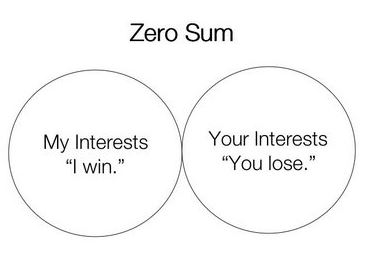
This begs the question, are freedom, justice and equality part of a zero-sum equation?  Is it impossible to raise people up without putting others down?  It would seem to me that there are some areas where a scarcity of resources means that this is true, but in the areas where we are dealing with non-tangible ideals, shouldn't we all be able to rise together? 

There are places where the two worlds overlap.  One example would be funding for education.  There are a finite amount of financial resources, qualified educators and technological supports available in the world.  We see funding becoming a large part of the struggle as different groups fight for a piece of the pie.  What is ignored is that our nation has the resources to adequately train, supply and support all students in their academic efforts.  We simply choose to fund other things.  The military budget, athletics and entertainment all sap resources away from our schools and into other venues.  We aren't putting our money where our mouth is when it comes to educating our people.

The problems are real and relatively easy to identify.  The solutions are in some ways just as simple, although not as straightforward to solve.  How do we reach a point where multiple viewpoints are always a part of our classrooms and society and we don't need a specific month or day to promote a groups contributions?  How do we reach a point where everyone feels like they have an equal opportunity and separate awards or Affirmative Action are truly no longer needed?  How do we reach a point where everyone assumes positive intentions from each other and the difficult issues can be addressed with honesty and trust?

I always tell my students that trust is one of the most important things we can have in our classroom.  If we can trust each other then we will accomplish much more than if we don't.  Once my students earn my trust I am able to give them more freedom in their studies and once they trust me we are able to work so much better together.  This is process that takes time and is a challenging one for many students. 

Unfortunately, trust is difficult to establish, but is very easy to lose.  This is just as true in the world outside the classroom as it is inside the school walls.  Trust isn't something that can be mandated, but must be earned through hard work and a demonstration of reliability.  We are beginning to realize the level of frustration and mistrust that exists in many groups in our society.  Often these are the groups that are not enjoying the same levels of success as other groups.  It stands to reason that, if you have been the object of discrimination and have a history of unequal treatment that trusting in the larger society would be a problem. 

In order to win that trust, our organizing efforts must focus on things that matter to all groups.  Too often we see organizations try and engage people on issues that are of importance to the organization.  Once again, the recall efforts, and most elections, stand out as examples.  Neighborhoods that rarely got visitors from "outside" were suddenly flooded with volunteers, knocking on doors, talking to the residents.  Asking for votes to support candidates who may, or may not remember the people who turned out to cast a ballot for them. 

This disconnect between organizations and their members isn't limited in scope.  Every individual member of a group has some level of frustration or feels underrepresented in some way.  In situations of extreme poverty or discrimination this is magnified, but we all feel like we have to struggle to make ends meet and to make our interests heard. 

One of the real struggles that unions have faced recently is the perceived need to be engaged in political issues.  Anti-labor forces have made the workplace into a political battlefield through legislation and policy designed to directly impact working conditions for unionized labor.  As a result unions have had to put significant resources into political actions that have drained financial and emotional capital.  Unions have been in a reactive mode and have scrambled to try and hold their ground.

However, in doing so it may be that unions have forgotten their roots.  Organized labor was born in struggle at a very personal level.  Workers rallied and organized to support themselves and their co-workers on issues of direct importance to them.  Political action and politics in general don't strike the same resonating chord for many members.  In other words the battles for the hearts and minds of labor is fought in the workplace and on the streets more than it is in legislative chambers.  We can't discount the need to be politically active, but you can clearly see the difference in engagement among union members when looking at the February, 2011 protests and the following two years of political action.        


It is also important for organizers to work at the personal or small group level.  We are dealing with some big issues and these are rarely addressed satisfactorily at the "macro" level.  We start changing the world at the "micro" level.  You can see that happening in classrooms across the nation where educators and families are working together to try and help a specific student succeed.  We often see families come in with "baggage" from previous educational experiences and the adults are filled with mistrust for the schools.  It takes time and a strong commitment to make change, but in doing so we can break the cycle and create hope for the future.

Face to face contact and actions committed with those we know are the most powerful.  It isn't easy to trust in a large group or in our political process on a large scale, but people are able to develop relationships with those closer to home.  The data that shows that most people don't think public schools around the nation are doing well, but who feel like their neighborhood school, or their child's educator are high quality, shows this reality well.  Even in organizations like MTI where a majority of members are supportive and engaged we see the power of individual contact when trying to mobilize our energy.  I've seen this personally at my own school and in the groups that I've been a part of over the past two years.  Making time to talk with people empowers everyone and opens doors that may have been closed previously. 

These are challenging, but exciting times.  There are the obvious threats to our rights and freedoms, but there are also the opportunities to use the conflicts to advance our society to new places.  This is virtually impossible to do through legislation, or through mandate from outside sources.  It also doesn't happen overnight.  Building a society where all are valued and all have equal opportunity takes time, effort and communication.  However, the results would make all of the hard work worth it.