Showing posts with label School Reform. Show all posts

Sunday, March 30, 2014

#158 March 30, 2014- Vote for Education


Spring Elections
(and Beyond). . .
Vote on April 1st!!!
Spring elections are notorious for their low voter turn-out.  Encourage every eligible voter you know to get to the polls next Tuesday and cast a ballot.  With the low expected turn-out, every vote counts even more in some very important elections.  Races for school boards and judges may not garner the attention that other contests do, but we've seen just how important these positions are in the continuing struggles locally and statewide.   


Madison School Board
There are two MMSD School Board seats up for election on April 1st.  Ed Hughes, current board president is running unopposed for one.  As a general rule of thumb I dislike "races" where candidates run unopposed.  Democracy works best when there is competition around ideas, beliefs and policies, and without competition candidates have little accountability to the public.

In all likelihood Mr. Hughes will win re-election, but we need to make sure that we stay vigilant and hold all of our elected representatives accountable for being informed and aware of the issues that are so important to our students and schools.        

The second seat is being contested between two candidates, Wayne Strong and Michael Flores.  The official endorsement lists don't give too much for voters to go on.  Both candidates have garnered a solid list of endorsements. 

He's best for Madison School Board because he's so involved and connects with struggling students.
madison.com|By Lee Enterprises

In a close call, Wayne Strong gets our endorsement for the Madison School Board.
madison.com|By Lee Enterprises

It is troubling that some of the endorsements have come with little or no real reasoning behind them.  In elections with the implications that this one has, endorsements should be given for strong and valid reasons.  Not, as the Wisconsin State Journal said, "Flores shares many of these concerns, but it is our sense that Strong is better prepared to hit the ground running."  What "sense" and what does "hit the ground running mean?"  If there isn't a strong reason to endorse, then why make this commitment to a candidate that the editorial board clearly doesn't feel strongly about?  Instead, either endorse both, or neither candidate.
While running for elected office can be very confusing, sometimes needlessly so. There are also few people outside of the far right wing, who do not think that money in politics is out of control. That being said, there are a couple of incidences on the Wayne Strong campaign that need to be looked a...
forwardlookout.com
For what it's worth, I'm "endorsing" Flores in the race.  His enthusiasm for our public school system, his personal experiences and his willingness to listen to all voices would add to a Board that needs to be a vocal supporter of our schools, students and educators.  He has demonstrated a clear understanding of the issues, and has been a visible presence in many Madison schools.  Not as a campaign tool, but simply because he cares greatly about what happens in every building across the district.  He has been an advocate for parental involvement, and we need to make sure that this is a priority in a district that too often seems overly bureaucratic and even "unfriendly" at times.   


Issues In Education
Why is this School Board race so important for the future of our schools?  One huge reason is that because of Act 10 and the continuing efforts of our state legislature and governor to control and privatize education in Wisconsin, we need strong local governing bodies to stand up to the outside pressures.  Local school boards and other elected officials become the first line of defense for our students, schools and educators. 
In addition, we are seeing significant changes in curriculum, policies and procedures happening in our district.  We need School Board members who will listen to all parties and be informed about the issues.  It isn't enough to have strong beliefs about what should happen in our schools.  We need individuals who will be able to make decisions that don't simply sound good, but that actually work for our students.

Issues like the Technology Plan, Behavior Education Plan and the new system of budgeting require more than just sound-bite, or simplified arguments.  They are complicated and must be addressed with care, concern and a significant understanding of a variety of issues.  The best decisions will be made if the voices of educational professionals, community members and families are blended together through an open and well understood process.  Something that MMSD has struggled with, but needs to improve on in order to create successful, sustainable plans that will move us ahead in the future. 
Thank you for taking the time to look over the third draft of the Behavior Education Plans for Elementary Students and Middle and High School Students. The plans represent a shift in philosophy and practice with…
legalsvcweb.madison.k12.wi.us


The battle for our public schools is intensifying, and we are in a critical time for the future of our schools.  Across the state and nation we are seeing efforts being made to drastically change the way students are taught, and to alter our schools in ways that aren't in the best interests of our students, educators and the community as a whole.  There are many important issues that we must work to address, but the current direction that education is moving actually does more to harm than to help.   

Preeminent education historian and public school advocate Diane Ravitch talks to Bill this week about the private sellout of public schools.
Bill Moyers

Is this education? Is this what we want for our children and grandchildren? Teachers have called the testing regime child abuse and here you get to read about it firsthand. A teacher's recount of t...
seattleducation2010.wordpress.com

Corporate education reformers are coopting the politics of race and labor, author Micah Uetricht explains
Salon
New York state legislators reach a deal to protect charter schools as Gov. Scott Walker pushes to expand charter schools in Wisconsin. Ed Schultz and panel discuss.
msnbc

These struggles are not external ones.  They are very evident across the state and nation, but they are also going on here in Madison.  Standardizing curriculum, emphasizing test scores and undermining the professionalism of educators are realities in schools across America, we certainly want to reverse these trends in a city that claims to value education and respect educators. 

Protecting Elections
Elections matter, and the current Republican leadership in Wisconsin recognizes this.  They also recognize that as demographics change and the effects of their policies are felt, they need to control elections and make sure the "right people" are voting.  This effort to restrict voting rights is very clear and has been articulated by many GOP leaders.  They have tried to garner support by claiming that there is extensive fraud in our electoral system, and while they have failed to produce significant evidence of fraud, this argument does influence the opinion of some voters. 

This week Governor Walker signed a bill that places limits on absentee voting and bans early voting during evenings and weekends.  Unlike bills that supposedly address voter fraud, and that have some support from the citizens of our state (often due to misleading information), this bill was passed despite 2/3 of Wisconsinites voicing support for expanding or maintaining current early voting times.  Clearly we need to rethink the idea that the GOP is the supporter of local control and less government interference in local matters. 

SB 324 puts politics ahead of people, aimed at suppressing the vote of seniors, minorities, and...
unitedwisconsin.com

Gov. Scott Walker should veto the partisan, anti-democratic legislation aimed at reducing voter turnout.
Milwaukee Journal Sentinel|By Ron Kind

The veteran moderate holds no fire in criticizing his party, saying it has lost faith in its ideas and is now resorting to shenanigans to reduce voter turnout.
madison.com|By Lee Enterprises

The efforts to control the electoral process isn't limited to legal restrictions on voting.  The ability of private citizens, organizations and corporations to buy elections is magnified under current election rules.  We have seen the impact that 3rd party advertising and the spending of large sums of money has on our elections.  This is especially true in local races where campaign budgets are often limited to small amounts.  Are the ads and mailings misleading, untrue, controversial?  Yes, to all of these.  However, they are also effective and powerful and allow special interest groups to buy their way into power.  

A mining town of 6,000 people isn’t too small for billionaires to mess with to get their way. Inside the race bringing in big money.
The Daily Beast

People power is the only thing that will change the current electoral trends.  This means that everyone becomes informed and casts a ballot.  It also means that we seek out, support and encourage candidates who will truly represent the people. Too often we see elected officials represent a limited number of constituents, or simply do what is necessary to maintain their positions and get re-elected.  We also see them flip-flop on issues when they strike close to home.  While I admire her courage and don't wish any illness or problem on anyone, the idea that a personal issue would change a vote is problematic.  When we elect representatives we do so with the understanding that they represent all citizens, this means that they do what they believe is right for the people, not any special interest, campaign contributor or even put their own interests above others.  By running for election, candidates put themselves in a position where they are held accountable to a higher standard of public service than regular citizens.   

A state lawmaker from Lincoln County who once opposed a bill that would force insurers to cover chemotherapy pills says she changed her position...
Daily Herald Media

We also need to be aware of the ways that public opinion is manipulated and our citizenry is controlled through messaging and other means. 

A Senate hearing on inequality featured an updated version of Reagan’s favorite “freeloaders”—now they’re white and middle class.
By The New Yorker

Traditionally, young people have energized democratic movements. So it is a major coup for the ruling elite to have created societal institutions that...
filmsforaction.org

The Good, The Bad and
The Ugly. . .
The Good . . .  As we watch "March Madness" we shouldn't forget that these athletes are bringing huge profits in for a wide variety of individuals, companies and groups.  At the same time, while they are often receiving scholarships, there are too many questions that can be raised about what type of education these athletes are receiving and what the real purpose of college athletics is.  As with many issues important questions to ask are, Who controls the process and who profits most from it? 

The National Labor Relations Board in Chicago has ruled that football players at Northwestern University are employees and can unionize, the board said Wednesday. In a statement, Northwestern acknowledged the ruling and...
WISC-TV / Channel 3000|By Channel 3000

NCAA Says Its Graduation Rates Hit Record High, But Important ...

thinkprogress.org/.../ncaa-graduation-rates-hit-record-high...‎
ThinkProgress
Oct 25, 2013 - NCAA The rate of NCAA Division I athletes graduating within six years of ... percent) and African-American men's basketball players (68 percent). ... According to ESPN, only one of the 10 teams that participated in the men's ...

A plug for Wisconsin Basketball, on and off the court. 

Wisconsin graduated every senior on its men’s basketball team the past two seasons, and is on track to do so again.
The New York Times|By Karen Crouse
This is the best way to counter hatred.

Bookmark this under "How to Protest the Westboro Baptist Church."
Mother Jones


The Bad . . . Just give it up already.  Suppressing speech is bad enough, but continuing to fight when you are clearly wrong is a waste of time, money and embarrassing to our state.  

The tickets were tossed out by a Dane County judge in February on constitutional grounds.
madison.com|By Lee Enterprises


The Ugly . . . We know that many places where the anti-government sentiment is the greatest receive some of the highest amount of government money.  If you don't like the system, don't take the money.
The extent to which the average American’s tax burden would vary based on his state of residence represents a significant point of differentiation...
wallethub.com

Sunday, July 21, 2013

Issue #122 Standing Strong for Education


What Do We Stand For?…
"A man who stands for nothing will fall for anything." Malcolm X
"A house divided against itself cannot stand." Lincoln
"Stand With (Walker or Wisconsin depending on your political persuasion)"

We've done a lot of standing with/for/against things in Wisconsin over the past couple of years.  The imagery associated with standing can be associated with strength, support, stability, or sometimes stagnation.  We can be seen as standing together to support a position or individual.  We can be standing strong against an outside force, but we can also be standing still and not moving forward.  This idea of solidarity vs. stagnation is an important one in the current political, social and economic climate.  It is an image with historical connotations and one that is a powerful motivator that unites supporters.  It gets at the heart and soul of our own individual beliefs and bonds us with others of a like mind. 
     

People may be familiar with the phrase, "My country, right or wrong."  This phrase has been used to describe unthinking support and could easily be extended to all areas of our lives.  It depicts a type of behavior that is automatic and based not on independent thought, but on a blind obedience or belief that we must stand behind all actions of a larger entity, even when we know that they are not proper.  This quote is actually the beginning part of a slightly longer quote attributed to Carl Schurz in 1872 that goes, “My country, right or wrong; if right, to be kept right; and if wrong, to be set right.”  Obviously, this longer quote has very different implications.  The idea that we should support our country (or any other organization, individual, philosophy or ideology), but should be willing to recognize the fallibility of any human activity and make necessary changes to it, is very different from blind acceptance and unquestioning loyalty.   


Because the current environment is so confrontational and antagonistic it becomes very important that we are choosing our positions carefully and defending (or standing with/for) the correct things.  We can't blindly stand with or against someone simply based on their political party, other associations or ideological viewpoints.  The more we base our allegiances on these types of characteristics the more divided our society becomes.  If our loyalty is based on a reflexive response and not from thoughtful, rational and well developed thinking we fall into the trap that has done so much harm throughout history.  We put ourselves on a path that has, too often, caused significant problems for so many.  Loyalty to a cause is a valuable trait; however, loyalty must be tempered with reason and a willingness to accept changes or to admit mistakes.

Along the process of discovering what we stand for we need to challenge ourselves to hear the opinions and beliefs of others who may disagree with us.  It is only through exposure to multiple ways of looking at an issue that we can identify the strengths and weaknesses of our own beliefs.  We live in a society that is diverse in so many ways.  This diversity is a strength, but one that isn't without challenges.  The positive aspects of our vast diversity can only be realized if as many voices as possible are truly heard in a meaningful way. 

Unfortunately, the hostile environment that currently exists in much of our public discourse makes it less likely that people will hear other viewpoints outside of their personal comfort zone.  We seem to spend more time looking for flaws in opposing opinions than we do looking for commonalities or positive aspects.  This causes us to miss opportunities to find compromises or even solutions to our problems and further divides groups in our society. 

It certainly isn't hard to see multiple examples of this phenomenon in modern America.  Here are a few from the last couple of weeks.  


One of the most vivid examples of our inability to communicate about challenging issues is the Trayvon Martin/George Zimmerman case. 
This case provides and example of just how complicated it is to have public discourse around a tragic and controversial incident.  Cases like this one serve as a lightning rod for people to score political points or to make sweeping commentary about issues of great importance.  However, lost in the hyperbole and rhetoric is the reality that we need to be able to move forward and work to escape our historical legacy of violence and inequality.

Unfortunately, it is too easy to take cases like this one and only hear one side of the equation.  Instead of uniting around the idea that no one should be killed, injured or feel unsafe in our society and working together to achieve a goal of peace and justice for all, we find too many people isolating themselves in a cocoon of fear and suspicion.  We worry more about "standing our ground" and defending our own personal space than we do about making changes that lead to a more unified and a stronger America.    

While there are many different ways to interpret this case and many issues involved, for me, in the end it boils down to a sense of community and belonging.  We will probably never know all of the details, or the full truth about why Zimmerman shot Martin.  That's the complex reality of human events.  However, it isn't difficult to see that the climate that exists in modern America lends itself to these types of violent incidents.  We have created a world where there is a clear sense of who belongs where.  Knowingly, or unknowingly we separate ourselves by age, race, gender, and countless other categories.  All of which are magnified in importance beyond an understanding of the basic humanity that should unite us.  Racial profiling by police, racial profiling in our daily interactions and an increasingly segregated society turn simple differences into potentially deadly divisions. 

George Zimmerman trial: Not guilty in shooting death of Trayvon Martin


abcnews.go.com

Issues around race are very difficult to discuss and come to any sort of positive resolution on.  They permeate through our history and impact virtually every aspect of our society from economics to education and beyond.  We can try to fix them through public policy, however, legislation and regulation can only go so far in changing our society.  Real change occurs on a more personal level.  Each of us is constantly searching for acceptance and a sense of belonging.  Unfortunately, for many this necessitates a rejection of those different from us.    

www.dailydot.com
Winner take all politics makes us all losers.  Wisconsin is a divided state and nowhere is this clearer than when you mention Scott Walker's name in conversation.  Once again this reality provides and example of why those who oppose his policies need to articulate our thinking and make it clear that we oppose them, not just out of spite or vindictiveness for some imagined wrongs, but for real substantive reasons.  Walker's supporters would paint a picture of his opponents as unionized dinosaurs living in the past, while Wisconsin Republicans try to move the state forward into a fiscally safe future.  Yet, there are very real reasons for opposing the political, social and economic policies that have been enacted here in Wisconsin over the past few years. 


An accusation, realistic or not, is a powerful weapon to be wielded against opponents in public discourse.  We've been told that there are massive amounts of voter fraud going on across the country.  In order to fix the "problem" many states have been working to enact stricter rules around voting.  Yet, the accusations of fraud don't appear to have much substance and seem to be more of a political tool than a real concern for protecting the sanctity of our electoral process.

Voter ID laws and voter fraud have been portrayed as a racial issue.  I won't deny the racism that is implicit in many of the so called "reforms" that have been passed by Republican dominated legislatures.  At the same time, to simply look at the changes in our electoral process through a racial lens limits the full impact that they have on our society.  Any attempt to limit the voice of citizens, for any reason needs to be viewed as a serious threat to our republic.     


Extreme actions lead to extreme reactions, which lead to more extreme actions, which lead to more extreme reactions…  There will always be a fringe element in any society that is willing to take issues beyond what seems to be a logical extreme.  However, when pushed too far, even more moderate individuals begin to react in ways that are confrontational or outside the typical.  The protests of February, 2011 provide an example of this.  People who normally wouldn't take to the streets felt obligated to stand up for their values.  The exclusion of the people's voice from the decision making process made "rebels" out of moderates. 

Now we see an escalating pattern of violence and militarization in the northern part of Wisconsin due to the controversy over mining.   


There is always hope.  None of these issues are unprecedented or unique.  We've been dealing with them for the entire scope of history and will continue to struggle with them into the foreseeable future.  What then is the motivation for us to continue to struggle for justice and equality for all citizens?  It would certainly seem easier to give up and simply try to protect our own personal interests.  The answer lies in discovering what we stand for and finding others of a like mind to work together with.  As Margaret Mead said, “Never doubt that a small group of thoughtful, committed, citizens can change the world. Indeed, it is the only thing that ever has.” 


 Standing Up for Public Schools…
The idea of standing for something is an important aspect of any individual's character.  We all want to believe that we are useful, contributing members of society and that what we do and value is important.  The attacks on public education have certainly challenged educators' self-esteem and core beliefs.  We have been told that we are not competent and are lazy.  We've been told that our methods of educating students are insensitive and outdated.  We've been told that our whole educational system is flawed and should be "reformed" or even eliminated.  Public educators truly feel like we've been blamed for much of what ails society, from budget woes, to the decline of the workforce, to racial divisions and inequities. 

Our public schools face attacks on many fronts.  Here in Wisconsin the most recent threat is the expansion of the voucher program.  


The attacks on public sector workers through Act 10 and the general disrespect for the education profession have affected the number of students looking to join the field. 


Of course these challenges aren't occurring only in Wisconsin.


Yet, even in the face of these assaults, we continue to fight to preserve, protect and promote our public schools.  There are many reasons why public educators work so hard to defend our profession.  For me it goes way beyond a simple desire to protect my livelihood.  It isn't about trying to justify the last 20 years of my life and the work that I've done as a public educator.  It's a real belief that our public schools and the work that goes on in them is a valuable, even vital, resource that our society needs in order to evolve and thrive. 

My fight also centers around the idea that we need to protect the interests of the children and families we serve.  Education for profit won't protect the "consumers".  We know that turning our schools into businesses will not serve those who need the "product" the most. 
      

In some ways this debate goes even deeper than just educational policy and developing the future of our society.  The struggle revolves around a constant tension between the real need to develop talent and to learn practical skills, and the innate drive to learn about the world around us.  The idea that everything in our society needs to have a practical application that produces measurable results is clearly demonstrated in many of the "reforms" that are currently attracting so much attention.  By quantifying and measuring the knowledge that our students achieve we are able to somehow make education more substantive and useful.  This is why, in many circles, a student pursuing an engineering major is held in higher esteem than one working towards an art history major.        


This is one reason that I continue to speak against the wave of testing and standardization of curriculum in our public schools.  It is not a desire to avoid accountability, nor is it a fear of trying new things.  Instead it is a reasoned reaction to the constant pressure to make the 9 and 10 year olds in my classroom "career and college ready".  I truly want what is best for my students, but if Margaret Mead (writing in the 1940's and 50's) felt that, "In the modern world we have invented ways of speeding up invention, and people's lives change so fast that a person is born into one kind of world, grows up in another, and by the time his children are growing up, lives in still a different world," then what are our children in the 2010's facing.  We have very little idea what the world will look like in almost a decade when these children will graduate from high school.  By limiting their opportunities to what a publisher who doesn't know them at all believes to be appropriate, and ignoring what those closest to them (families, educators, and community members) see daily we do our students a huge disservice.  


This is not a phenomena limited to the United States either.  The results can be disastrous for any individual.  One of the comments after this article sums up the potential damage well:
"Absurd. I sat the old 11-plus in 1946. My father had recently returned from the war a broken man and on the day of the exams I suffered both a hay fever attack and a migraine. For that I was categorized a failure. It took me over ten years to recoup and to follow a career in education to university level."
 

This constant drive to quantify the level of education and sort our students creates a real problem in many ways.  Testing and collecting data become a driving force in education instead of focusing on student learning.  We put as much, or more, energy into designing assessments and scheduling tests as we do on actually educating our students.  So much of a district's budget and resources are devoted to this data collection that we lose sight of what is really important. 

 http://unitedoptout.com/opt-outrefusal-guides-for-each-state/
This idea that education should be assigned a value carries beyond the school walls and into all aspects of discussions around education.  Nowhere is this more apparent than in discussions about the school budgets that are created annually.  The headlines may blare “PROPERTY TAX INCREASE" but the reality is that these increases are due to the decisions made higher up the food chain at the state and national level.  These decisions are made, not to improve education, but to gain and hold on to political power.   What if the headline about the school budget mentioned the fact that it is decreasing by a half-percent from last year, or that the tax increases resulted from an $8.7 million cut in state funding to MMSD? 


What is just as clear in educational issues, as in any other societal concern, is that individuals working together can make a difference.  Many people spoke up about the need to continue holding conferences at the start of the school year in Madison's elementary schools.  These conferences help set goals for students and establish communication and a working relationship between educators and families.  School administration and the Madison School Board heard these concerns and worked to make sure that the conferences will be held again this school year.   


Small groups of thoughtful, committed people are working all over our city, state, nation and world to try and bring important educational issues into the public debate.  While the challenges are many, the potential results are well worth the struggle. 

Sunday, October 7, 2012

Issue #82 October 7, 2012- Testing and New Contracts


What This Is…
Issue #82- October 7, 2012
In this issue: Standardized Testing, MMSD Educators Under Fire

Testing, "Mapping" a Road to Nowhere…
Assessment is a vital part of the educational process.  Educators need to know what their students know and we use assessment to guide our instruction as well as inform us about student progress.  Parents and other adults in students lives want to know where their child stands in their educational development.  Educators share information gathered from assessments, student work and other observations with families in an ongoing effort to support student learning of important skills and information. 

Unfortunately, assessment has become a "tool" used for an entirely different purpose.  So called, "reformers", want to assess children in order to rank and evaluate educators and schools, not to make education better, but to somehow document our success or failure in educating young people.  In doing so, they've turned education into a form of competition where we can identify schools that are successful by their numerical rank or by some other formula based on data collected by standardized testing. 

We have an epidemic of testing that has broken out in our nation's schools and it is deadly to learning and student achievement.  I could spend some more time looking at this issue from a "big picture" perspective, but there is another reality that is much more important than the political or sociological one.  That reality is the one that I work in on a daily basis.  It is populated by a cadre of dedicated educators and caring families.  The primary inhabitants, in fact the ones for which this environment is created for, are the students who come each day to work and learn in my classroom (and in classrooms around our city, state and nation).

We can debate issues and policy forever and never come to a satisfactory conclusion that will please everyone.  However, on an individual basis in classrooms everywhere the success or failure of our public schools is easier to define.  Every year I sit down with families and students and we identify needs and goals for the year.  Over the course of the year there is constant assessment, evaluation and a flow of communication between home and school about the students I serve.  All of us work together to try and find the best ways to make sure that students are learning necessary skills and information that they will need in the future. 

In many cases this isn't a smooth or easy process.  Growth is rarely linear and constant, but the important thing is the collective effort and cooperation between home, school and the community.  We may agree or disagree about the methods we use to educate any given student, but in the end it is the student whose needs take the highest priority.  We try different ideas and utilize different resources, all while maintaining the focus on the child.

This is true for a majority of the school year, but there are too many times where this cooperative effort is disrupted and undermined by the intrusion of mandates from outside sources.  Sometimes these interruptions are simple, isolated problems that are resolved quickly, but there are also some that are symptomatic of a larger pattern that is emerging in our public education system. 

An example of these types of disruptions are the changes implemented for elementary school educators Monday afternoon planning time by MMSD administration.  By taking time that had been available for educators to use independently and using a significant amount of that time for formal professional development or other meetings we lost time to communicate with families and other educators.  In the last round of contract negotiations our district's administration offered the idea of changing staff hours and making us have planning time in the morning, before school.  That is another time when many educators are able to communicate with the families of their students.       

Educators in Madison have fought to try and preserve as much of our previous schedules as possible, and to some degree have been successful.  However, there is another, more disruptive, intrusion into our time with students and our communication with families…standardized testing.  This testing takes up a significant amount of instructional time, undermines student's efforts and results in misleading information that confuses and frustrates families.

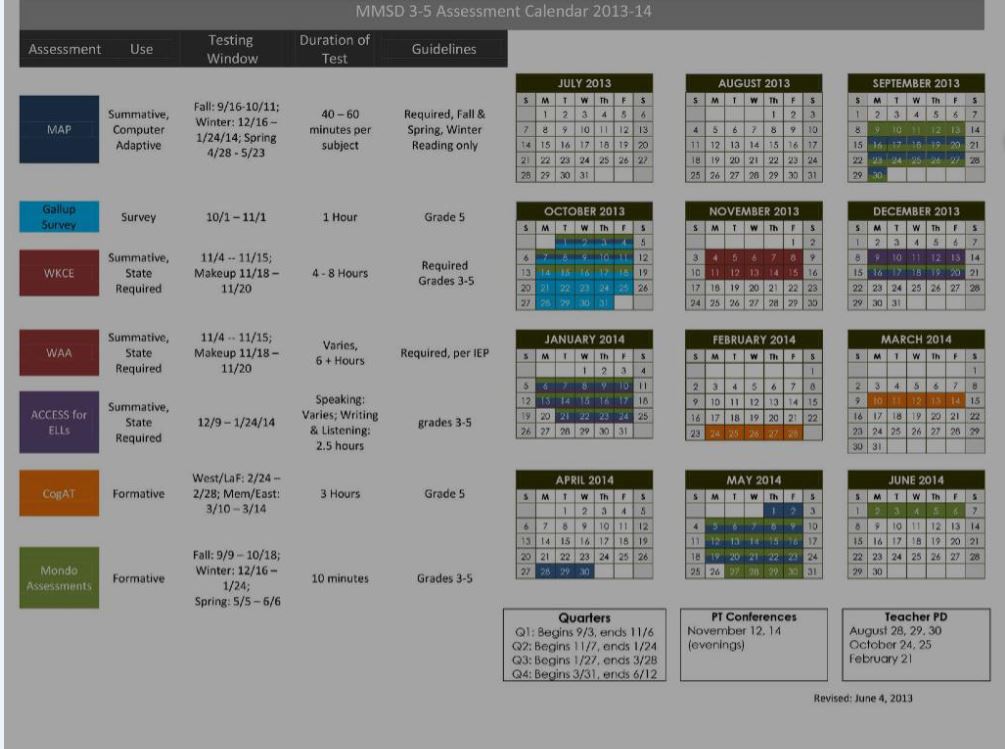
How much time is significant?  I knew we spent a lot of time testing, but recently was asked exactly how much and added up the hours.  Between the three MAP sessions, the WKCE, the COGAT and additional testing required by MMSD to meet guidelines imposed by legislation and education policy the number is too high.  You can't forget the amount of time spent preparing for testing in this number as well.  The result?  Specific numbers vary by grade level, but the amount of time used for standardized assessment is extensive.     

More time must also be considered lost as schedules are altered to accommodate testing as well.  Students at this grade level don't just test and then switch to another topic without needing time to recover.  We also want to make sure that they are performing their best so we change our curriculum during these testing periods and reduce their workload.  This results in more lost instructional time for students at all elementary grade levels.  Because different grade levels have different testing requirements and many Madison classrooms have combined grades this adds to the disruptive effects of testing.   

The time lost becomes more significant at lower grades where students are not capable of taking individualized standardized tests and therefore must be tested individually by trained professionals, usually teachers.  The result is that these students who are most in need of instruction lose the learning time with their teacher in exchange for assessment time.    

In many school buildings a tremendous amount of effort is put into attempting to minimize the impact that testing has.  The results are a cobbled together, "best of a bad situation" solution.  What is missing from the current discussion in most schools is not, "How do we make this work" but instead should be, "Why are we contorting our schedules and disrupting our student's educations for these assessments?"  As soon as we move the focus of our discussion away from asking whether our assessments are useful and good for students we lose the true meaning of education and assessment.  We become proxy advocates for testing by adapting our curriculum and schedules to fit the tests not the students. 
 
The assessments affect individual students in different ways, but the results are rarely positive.  Educators are under pressure to administer these tests and often the testing environment is quite different from the daily classroom environment.  In most Madison classrooms students are encouraged to ask questions, challenge ideas and work cooperatively to learn about any given topic.  Standardized testing is an entirely different situation and many of our students struggle to adapt, even with significant test preparation instruction.

In fact standardized testing creates a negative atmosphere and reduces each student to a number, or box to be filled in.  Exactly the type of situation that we are trying to avoid as we work to engage and motivate our highest risk students.  Because we can't leave any child "behind" we must force students who already have fragile and tenuous connections to school to sit isolated and prove that they are struggling academically.  I won't mention specifics (to protect student anonymity) but I have seen testing negatively impact many students in my years of teaching, and the effects are increasing as the testing becomes more intense and more value is placed on the scores.  Watching students take a standardized test and seeing their heads drop, the tears flow and their frustration build hurts me as an educator. 

Standardized testing forgets that these are children who have a very different idea of what they are doing during the testing than the adults who create the tests do.  I have many examples of this that I have seen during my 15+ years as an educator.  In fact my own experience with standardized testing offers an insight into why we need to take all testing results with a "grain of salt".  I have always tested well, usually scoring quite high, but I remember my mindset wasn't optimal during testing.  As a big baseball fan (and unfortunately for me a Cubs supporter) the A/B/C/D/E choices became the Astros, Braves, Cubs, Dodgers and Expos.  Naturally my default answer was "C", Cubs. 

I've heard my own students talk about their thoughts during testing and the discussions don't increase my faith in the test results.  A recent student said their favorite part of the MAP testing (done on the computer) was "clicking" (believe it or not, this student needed repeated interventions to stay focused during testing).  I've heard many teachers talk about their difficulties in getting students to perform their best on tests that mean little to them personally.  The lack of direct connection to topics we are working on, the seemingly random nature of the questions and the disruptions to school routines all contribute to student's disconnect with the tests.    

We often seem to forget that we are taking students who are young and just developing their skills and shaping their ideas about education.  For the majority of the school year we work closely with them and encourage their progress.  Then during these testing sessions we change our interactions, enforce a whole new strict set of rules and emphasize their performance in different ways.  This makes students feel uneasy and magnifies the importance of the tests in their minds.  It certainly doesn't help that those students who stay up on current events see the importance that adults outside of their school experience place on the test results either. 

The reporting of results provides another set of variables that decreases the usefulness of standardized tests.  It is difficult to convey to families and students what their scores mean.  After students finish their MAP test, their score appears on the final screen.  As we leave the computer lab I find myself besieged by students clamoring to know what a 214, 201, 197, etc. means.  Of course their WKCE scores have an entirely different scale, and other assessments also use different values to measure scores.  As educators we are placed in the position of translating numbers to families when we really should be talking about other aspects their child's education.

The way the test results are used is also troubling.  I have had students who were struggling in significant ways denied access to additional support or Special Education evaluations because their test scores were not low enough.  At the same time I have seen students offered or excluded from TAG recommendations based on these scores.  These things happen even when multiple educators and student's families speak up and advocate for students needs.  The test score becomes the most valued data about a student, while those who know the child best and who have professional experience are left trying to justify their opinions that have been formed by observing the student on a daily basis. 

As an educator I have no problem with accountability.  I expect the most from myself and my students.  I want feedback and constructive opinions from families and welcome evaluations from my administrators.  Accountability isn't the issue here, the real issue is that I want to be held accountable for the right things.  I want my students to be able to lead happy, productive lives and to have an educational background that will support their efforts.  That is what I work towards, not higher test scores that measure vague, ambiguous skills whose value is determined by some source far removed from the lives of my students and their families.    

In the end, the test scores become another way to divide people who attend, support and work in public schools.  Programs and educators are evaluated on the merits of their ability to improve a student's test taking ability while ignoring the fact that these tests are only on measure of student progress.  We have huge issues with equality of opportunity in our society and our educational system reflects the disparity between the "haves" and the "have-nots". 

Testing our students won't eliminate the Achievement Gaps, but it certainly provides ammunition for those who would radically change our educational system.  Standardized tests can provide some useful data, but shouldn't be employed at the expense of other forms of assessment that will help improve the instruction that students receive.  Until educators, students and families unite to challenge the dogma that standardized testing is a valid and valued way to evaluate our schools and students we will find ourselves continuing down a path that leads to educational ruin.             


Madison Educators, Between a Rock and a Hard Place…
It's difficult to know how to react to the recent negotiations and ratification of contracts for all MTI bargaining units and the AFSCME units who work in MMSD.  On one hand there is relief that we were able to get a contract that protects us through 2014.  On the other hand is the bitter taste left after seeing what the future of public educators in Madison will look like unless we are able to change the existing climate that surrounds our schools.

There is no doubt in my mind that we didn't receive the respect or the contract that we deserve.  I know that conservatives would agree with this statement, but for different (less friendly) reasons.  The contracts that were negotiated leave Madison educators still well off when compared to other school districts or public employee unions in other parts of Wisconsin.  Our negotiating teams were able to preserve many parts of our collective bargaining agreement and even were able to remove the threat of wage reductions for our hard hit hourly employees.  


The protection of a contract for another year gives us more time to work on building support for our efforts to protect public education and more time to work to educate the general public about what is happening in education "reform" movements.  We have an obligation to define our positions regarding education reform and to take the lead in creating an atmosphere that allows for change, while still protecting educators and public education.  It allows educators in Madison a reprieve from the immediate threats of a handbook and the challenges that new policies would bring to our daily labors with students.    

That this was accomplished while we were backed against a wall and had a short negotiating window with little leverage to bargain with is truly remarkable.  It is also a testimony to the support that Madison educators enjoy from the public and from some of the School Board and parts of our administration.  We shouldn't forget that the district didn't have to bargain, but could have waited for the legal challenges to be decided.  Their refusal to consider some of MTI's proposals or to budge on some of their demands showed the disparity in power that exists in current labor/management relations. 

While it would be wonderful if district administration and the educators they employ could work together, it is clear that there are different agendas which make cooperation difficult.  This is extremely unfortunate.  Now is the time when all those involved in public education from the top administrator down should be finding common ground and not fragmenting in the face of the attacks by "reformers".      

There are several troubling things about this current round of negotiations. 
Bargaining with employees should be a reasonable expectation and not considered an act of generosity.  The concept that we were lucky to even get a chance to negotiate a new contract shows just how distorted things have become in Wisconsin. 

Many of the MMSD proposals read like a blueprint that would be supported by educational "reformers" who look to privatize public education.  As it ended, there is still the potential to change the way our schools operate under this new contract.  The antipathy that developed during the Madison Prep debate appeared during the negotiations as MTI was portrayed as an obstacle to student achievement by some MMSD negotiators.

Under current labor conditions it is very difficult to adapt existing contracts to new or different ideas.  In the past contracts could be altered by both parties agreeing to do so and creating formal "amendments" to the contracts.  Now, under Act 10, unions and school districts have lost that flexibility.  Who knows what MTI and MMSD would be able to do if real bargaining could be done. 

The educators who make up MTI are committed to improving student achievement and it is insulting to assume that we aren't.  We are also committed to making sure that educators are treated fairly and that working conditions are reasonable for all educators.  This can sometimes cause difficulties as new programs are implemented, but often results in good dialog that makes for stronger proposals in the long run.  

It is clear that there are those in MMSD who would like to see MTI disappear and be given complete freedom to control the employees in the district.  Some of the sticking points in negotiations showed this to be very true.  For example, all MTI represented employees could pay up to 10% of their health insurance premiums under the new contract.  Teachers, the largest number of MTI members, offered to pick up the entire cost of any insurance premium increases for the other units.  These units have been the most impacted by recent reductions in take-home pay.  However, MMSD refused this, even though it didn't affect student achievement and would not have impacted the district's budget.

The initial proposals offered by the district were a terrifying look into what an employee handbook might look like in the future.  The proposals take us in a direction that leads towards privatization and the struggles that other urban school districts have already encountered.  It is clear that public education in Madison is facing dire threats to its survival. 

Public education needs to be just that, public, and part of this public nature of things is the participation of groups representing all concerned parties.  In the case of public education this means that input from many sources, including educators, needs to be heard.  We can't run our public schools like a business and ignore the concerns of the professionals who staff our schools.  The process that existed prior to Act 10 may not have been perfect, but it allowed multiple perspectives to be heard when issues were bargained.  I hope that future discussions will keep this in mind and that we don't allow any single group to dominate the conversations as we work to improve our schools for all students.

As educators we need to keep this in mind as we work to build connections with the communities we serve.  In some cases MTI is seen as an impediment to progress and we must make it clear that our concerns are presented in ways that reinforce our commitment to making schools good places for everyone to work and learn.       

It is said that in every cloud is a silver lining and that is how educators here must approach the negotiation and ratification of our contracts.  Our negotiating teams and MTI staff won us another year to continue the fight to protect public education and to preserve our labor rights.  Madison has often been a leader in both of these fights and we have the opportunity to be in the forefront again. 

We must use this extra time to build support within the community and to share our message with the general public.  It is distressing that so few in the community know about or understand the importance of public education.  We need to build connections with all parts of the Madison community and develop working relationships with the people who live, work and raise children in this city.  We have to listen to them, recognize their needs and work to build a school district that serves all parts of the population effectively.

We need to clarify our positions and demonstrate the willingness to work with different groups while still protecting the things that we value.  The issues around Madison Prep provide an example of how different organizations that want the same thing can come into conflict.  By clearly articulating our points of view and connecting with other groups, compromises and discussion can occur.  If all parties operate in good faith, with the interests of the students as the primary focus, then positive results will occur. 

Of course all actions have consequences and we can't sacrifice future generations of students by gutting our public education systems in the present.  We have seen how privatization has negatively impacted schools in communities across the nation.  The "tool" used by supporters of privatization has been the need to address a "crisis" in public education.  We should be wary of these quick fixes and look towards building sustainable reforms that are focused on the good of the most students possible.       

MTI's membership must also work to develop solidarity and strength.  Too many of us have been content to let a small number represent our interests.  We are all ambassadors for our union and for public education.  We also can't forget that the things we are losing took years and significant struggle to gain and concessions now mean a repeat of these battles.  We have time, it may be "borrowed", but we do have the opportunity to build an even stronger organization to represent public education and public educators in Madison.  Our efforts will provide support and motivation for other educators around the state, just like the Chicago teachers inspired us. 

We may be tired, we may be angry, we may be disheartened, we may be all that and more.  However, at the same time we are educators and we are proud of our profession, our schools and our union.  The solidarity exhibited during negotiations spread through all MTI and AFSCME units.  Now we need to work on strengthening the bonds that unite us while spreading our solidarity to our community.  Each of us owes our best effort to each other and to our students.