Showing posts with label Election Ethics. Show all posts

Sunday, July 29, 2012


What This Is…
Issue #73- July 29, 2012
In this issue: A Citizen's Responsibility, Walkergate and Issue Updates

Our Civic Duty…
I've written quite a bit about the competing visions for our nation that currently are competing for control of our nation in the political, economic and social spheres.  It appears that the extremes on both sides are dominating the debate over issues that are of importance to all of us, no matter our race, religion, ethnicity, gender, etc.  It is becoming clear that neither extreme provides a long term, realistic solution to the problems we face that will allow our nation to remain a truly united country.


Unfortunately, the current political climate is forcing our politicians to adopt positions that are increasingly farther from what most of us believe and want for our society.  This extremism combined with an increasing reliance on short sound-bite media coverage means that we are in an era of one-line, limited context political grandstanding.  Our information about policy comes at us quickly and in a disjointed manner that makes it difficult for most citizens to form an accurate picture of what is going on.  People form their opinions based on headlines, hearsay and propaganda.

What we are seeing is a trend towards political grandstanding and divisive politics where substance is valued less than style.  Political leaders are using the struggles and suffering of citizens to score political points and promote their own interests instead of looking for ways to help promote the general welfare of the people they represent. 


At the same time many of our political leaders are failing to uphold their duties as representatives of the people, small groups of wealthy, influential people are asserting their power to promote their personal agendas. 


We, the people, remain our own best defense in promoting quality government that represents the best interests of our society as a whole.  Each of us has a responsibility to stay informed and to hold our elected officials accountable.  We need to support politicians who listen to, and represent their constituents and vote those who don't out of office.  Our representatives need to know that we are aware of their actions and that we will support them when they do their jobs well, and hold them accountable when they don't.

We must also continue to work to make sure our fellow citizens are aware of what is going on.  Recent electoral history in Wisconsin shows us that the public is continuing to buy a message that doesn't hold true under scrutiny.  We will be facing a series of very important elections over the next few months and our efforts are vital as we work to preserve and protect our values of freedom and social justice.   

Walkergate…
Wisconsinites have long mocked other states' (most notably Illinois) reputations for their corrupt public officials and crooked politics.  We looked at the shenanigans going on in other places with disdain and touted our relatively clean political status.  Now it appears that we are leaving the "clean politics" rank and plunging headlong into a trough of corruption and illicit political acts.

While it is certainly difficult to find politicians in modern America who are free from the taint of big money and other outside influences, Wisconsin's politicians are quickly gaining a reputation as being among the most corrupted.  In fact the general tone on-line seems to have switched from a predominantly supportive and sympathetic one to a "you deserve what your state voted for" theme.  Based on the fact that we have the only U.S. governor with a legal defense fund, legislation drafted by special interests and now a sitting justice with a legal defense fund, it is difficult to counter these attacks. 

For those who thought that the recall was unmerited because Walker hadn't done anything criminal, keep an eye out on the continuing stories surrounding his administration (both current and past).      


Issue Updates…
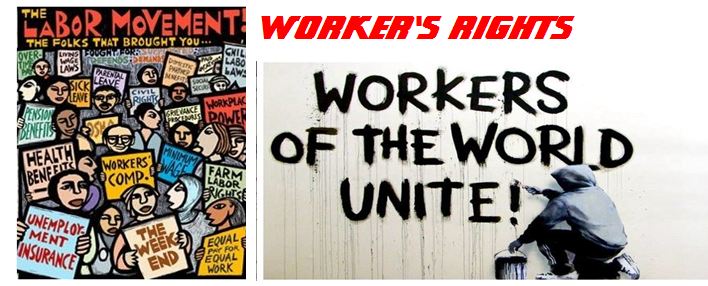
Many people continue to see the struggle for worker's rights only as a political conflict between unions and conservatives.  This narrow view of the struggle gives an advantage to anti-labor forces who have aggressively attacked unions as being greedy, wasteful and a negative force on our economy.  Conservatives, heavily supported by corporate and other business interests, have been able to "divide and conquer" workers by preying on the struggles that many middle and working class citizens are facing in these difficult economic times.  


The bigger picture shows us may disturbing trends in the workplace as workers are paid less, work more and face more dangerous and unpleasant working conditions.  It is clear that there is a concentrated effort being made to protect the interests of management over those of a majority of workers.    


There is no doubt that workers in America need to "wake up" and become more engaged in protecting their rights in the workplace.  Conservatives are playing on a historical American fear of socialism and communism, but phrases like "Workers of the world, unite" have a place in American society and American economics.  Time an time again throughout our history we've seen the effects of severe economic stratification and it has never been peaceful or productive.  It is time for the middle and working class of America to exert their strength or else we will face a long, difficult and unpleasant struggle to regain what we have lost.   


This past year has seen Wisconsin regress significantly in many ways.  We've set the clock back 60, 100 or more years in many social, political and economic areas.  Our treatment of children and our public education system is no exception to this.  Many people would like to see us go back to the "good-old days" with regards to public education.  For these people this would mean a return of straight rows of desks, children being seen and not heard and a back to basics curriculum.  What is ignored in this model is the fact that we must expect more from our students than what we did in the past.  How can we expect our children to compete in the future if we use teaching methods and school models from the 1950's? 

What is most frustrating is that many of the attacks on public education are not based on realistic criteria.  Instead of accurately assessing our efforts to educate our young people, we rely on standardized tests and other flawed measures.  Then, using these "facts" we hear about the failures of public education and the need for massive reform.   


www.washingtonpost.com

I've said it many times before, I don't believe that our public schools are perfect institutions.  Every human endeavor is in constant need of monitoring and improvement.  However, our current school systems have the potential to meet the needs of the most students and need to be supported and further developed. 

Public schools are being attacked for many reasons, but one of the primary ones is the continuing issues surrounding Achievement Gaps.  We have always had students with different needs and different abilities.  In the past we segregated schools for a variety of reasons and excluded children based on different physical, emotional or cognitive reasons as well as race, gender or other physical characteristics. 

Modern public schools are mandated to be inclusive and provide services for a wide range of student emotional, academic and physical needs.  This is a mandate that most educators embrace and, while challenging, also provides many positive opportunities for everyone involved in the educational process.  With adequate support public schools provide excellent opportunities for students who attend them.  Unfortunately, we are seeing fewer and fewer resources allocated for public education while more demands are placed on educators.

We are also seeing a disturbing trend of increasing segregation of our public schools.  As our schools segregate based on race and social class we see a return to the separate and unequal education that previous generations experienced.  The stratification of our neighborhoods, combined with the illusion of choice provided by the privatization of education accelerates the segregation of our public schools.   


Along with the segregation of schools we can't ignore the impact of the recent "reforms" that have been enacted here in Wisconsin regarding public sector unions.  Governor Walker can try and spin his policies by saying they are good for education, but in reality they are only good for the bottom line of business owners and special interests.  Claiming that reducing state spending on education by $1.6 billion in the last budget is a positive step for Wisconsin students is ridiculous.  Walker's reforms make our most vulnerable students even more "at-risk".   


Public educators are facing an uphill struggle as we face threats to our employment along with declining working conditions and increased animosity towards our profession.  Many of us are facing a difficult choice as to whether to remain in the field or to move to "greener pastures".  Those of us who are committed to improving educational opportunities for all students must be vigilant and ready to defend public education.  


It is surprising to many people that the United States Constitution originally left much of the discretion about voting in the control of the states.  Gaining the vote has been a struggle for many groups throughout our history and voting has become established as a right that most of us expect to be protected through policy and legislation.  Over time our national government has exerted more influence over who can cast a ballot in an election.  However, states still maintain their rights to set the rules for elections as long as they don't violate the Constitution or Federal law. 


The GOP has seen an opportunity to attempt to cement their political power by imposing restrictions on voting at the state level.  They have misrepresented facts and mislead the public so that many citizens are fearful of widespread voter fraud.  This fear has allowed the GOP in Wisconsin to try and implement one of the most restrictive voter ID laws in the nation.  The full effect of these efforts is still undetermined, but the intent is clear.    


The real damage to our electoral system may not be as much about who can cast a ballot as it is the quickly eroding confidence that our process of electing officials is honest and accurate.  Unless there is a significant change in laws at all levels along with a radical change in the interpretation of the Constitution, we should see most citizen's right to vote protected for the near future.  


What is disturbing is the idea that a person's vote may not be counted accurately and that the "real fraud" in the system is much bigger than any individual voter.  This lack of confidence in the integrity of the system does more to disenfranchise citizens than any single piece of legislation.  Our democratic traditions and the foundation of our government is threatened by the lack of public confidence from all sources.  After all, if don't respect the process, how can we respect the office holders who emerge from it?       


The past year has seen many families torn apart by the political upheaval in Wisconsin.  If families can't discuss politics without "fireworks" than it stands to reason that business and politics wouldn't mix well either.  Many smaller businesses have tried to stay away from making broad statements about their owners personal beliefs for that very reason.  While they may share their ideals with regular customers, or make their social, political or economic statements through their choice of products or treatment of employees, they refrain from making broad statements regarding specific issues. 

This is true for many reasons, but I would guess that the main reason is that it makes good business sense not to alienate any potential customers.  As a consumer I have the right to spend my hard-earned money on products and at businesses that support my values.  I consciously choose to make my best effort to purchase goods and services that I feel good about.  That's my right as a consumer and I respect the rights of anyone else to do the same. 

Business owners also have the right to their political beliefs, but need to be ready to accept the consequences (positive and negative) for expressing them publically.  What makes the ethical positions of these larger business owners more important is their ability, under current political finance laws, to influence public policy.  By choosing to exert an inordinate amount of influence on our political process (either individually or in groups), business owners have inserted their personal politics into their business world.       


Sunday, February 19, 2012

Issue #50- Thomas Paine 2012 and Calvin Coolidge


What This Is…
Issue #50- February 19, 2012
In this issue: Recalls and Elections, America's Dual Personalities- Money or Virtue

Recalls and Elections…
There is no doubt in my mind but that we are currently engaged in a crisis that challenges the continued existence of democracy as we know it in America.  Democracy is a well loved and little understood aspect of our society.  We are fond of talking about what American Democracy means.  We are constantly reminded of what our democratic traditions are and what our "Founding Fathers" intended when they created the framework that guides our political system.

Conservatives are especially fond of using our history as a "tool" to justify and/or guide their policies, words and actions.  However, history isn't a sound bite.  It is a collection of knowledge imbedded in a larger context.  Take for example the famous words of Thomas Paine written in December, 1776, " THESE are the times that try men's souls. The summer soldier and the sunshine patriot will, in this crisis, shrink from the service of their country; but he that stands by it now, deserves the love and thanks of man and woman."  Many of us know these words, but Paine continues on and has a great deal more to say about the situation he finds himself and his fellow colonists in.  I've put some of these quotes (from the same written work) throughout the following discussion on the current political situation in Wisconsin.  

The past year has seen important events occurring at a frantic pace.  The outcomes of these events remain to be seen, but what has unfolded here in Wisconsin is extremely troubling in nature.  The assaults on our democratic institutions and traditions have taken on many forms. 

The separation of powers and the checks and balances (both Constitutional and political) that have protected the rights of the citizens of Wisconsin have been weakened and/or ignored.
-The powers of the executive branch have been increased in a variety of ways that undermine the ability of the other two branches of government to control the executive.
-There has been blurring of the lines between the branches of government and evidence of unethical cooperation between the branches has been observed and documented.
-We've seen the effect of one party dominance of all three branches when the majority party wishes to ignore or trample over opposing viewpoints.
-Minority party members have been excluded from the decision making process and have not been allowed to have a voice in the crafting of legislation and policy.
-Party affiliation has become more important than considering an issue based on its merit and impact.

The ability of the common citizen to communicate with their elected officials and to exert influence in the political process has been restricted.
-The passage of a restrictive voter ID law disenfranchises some voters.
-A small number of well connected (and well financed) individuals have disproportionate influence on the policies and legislation that is considered and enacted by our elected officials. 
-Access to public buildings and public officials has been restricted or denied.
-Meetings and debates are held behind closed doors, at odd hours or in inconvenient places that benefit a few and not the many.
-Public debate has been eliminated, restricted or limited in nature with the people on the outside of the process looking in.


Actions of the government have targeted specific groups or interests and have been aggressively destructive to those groups/interests.
-The needs/wants of the minority have been promoted over the interests of the majority. 
-Groups like public workers and organized labor have become scapegoats for the problems that we face in Wisconsin.


(Mis)Information has been used to divide the people of Wisconsin as well as to create an atmosphere of crisis and panic.
-Data is used to manufacture a crisis and enact legislation one year, while similar data is used in different ways the following year.
-There is an active effort to pit different groups against each other to shift attention away from the actions of the political leadership.
-Political messages and other means of communication are designed to mislead the public and confuse people so that they vote against their own interests.

"But, before the line of irrecoverable separation be drawn between us, let us reason the matter together: Your conduct is an invitation to the enemy, yet not one in a thousand of you has heart enough to join him. Howe is as much deceived by you as the American cause is injured by you. He expects you will all take up arms, and flock to his standard, with muskets on your shoulders. Your opinions are of no use to him, unless you support him personally, for 'tis soldiers, and not Tories, that he wants."  -Paine
The type of political/social/economic climate is not unique to Wisconsin in the 2010's.  We've seen these things happen throughout the history of our state and nation.  All political parties and interest groups actively work to promote policy and legislation that will benefit their needs the most.  What is different about the current situation we find ourselves in is the scale of the attacks and the willingness of the conservatives here to go to nearly any length to promote their agenda. 


The results of the methods used by the GOP in Wisconsin are a divided state and a government that is unable to perform its duties in a responsible manner.  Up until recently we had what I believe to be one of the better imperfect political systems around.  The fact that a majority of people would express some form of displeasure with their government, while at the same time being able to function within the framework provided by our government was a positive thing.  Our leaders were able to work together and compromise in ways that, while not ideal at times, were at least functional.  I say this while recognizing the difficulties, challenges and inherent unfairness that were a part of the system.

Under the current conditions we see a reversal in the ability of our government to govern.  Rabid partisanship along with the apparent indifference to general public opinion have made it so our governing bodies are mired in perpetual arguing with little ability to influence their opposition's opinion.  The "debate" over the budget repair bill is an example of how the system failed.  The recent legislative sessions, or any recent Supreme Court ruling provide us with additional fodder for my argument.  More time is spent placing blame than is spent governing.   


After the ability to have their opinions heard were reduced/eliminated and after seeing the majority party trample the minority party's efforts to influence legislation the common citizen had very few options left to exert influence on the political system.  The results have been the mass protests and the recall efforts that engulfed Wisconsin over the past year.  I think that most of us would argue that protests and recalls are not the best way to govern a state.  They are the symptoms of a divided state and a political system that has failed to represent the people.

However, they are also the symptoms of a rebirth in democratic values and a reawakening in political activism.  Activism that is necessary to reverse a gradual process where a small number of citizens have purchased enough political power to effectively create a government that caters to their needs more than it represents the people.  The people of Wisconsin have seen the future as it could be under this type of government and have resoundingly spoken out to change that future for the better. 

"…a generous parent should have said, "If there must be trouble, let it be in my day, that my child may have peace;" and this single reflection, well applied, is sufficient to awaken every man to duty."  -Paine

To those who say that the recalls and protests were unnecessary, overly negative and/or undemocratic I ask what would you offer as the alternative.  Those of us who participated in these activities see them as the last recourse to a government that has become increasingly unresponsive to the needs of the people it is supposed to represent.  A government that was not only unresponsive, but also antagonistic towards the needs and rights of many of its citizens.  Protests and recalls are not a new way of governing, nor are they a method of political action that should become the norm.  Rather they are the attempt of a large number of people to peacefully reclaim a system that has failed them.


A legitimate question that is raised by the events of the past year involves looking at what the future holds.  Has American style, representative democracy become a system that is unable to cope with the current political situation?  I strongly believe that our political system is capable of adapting to the ever changing environment it exists in.  However, in order for democracy to continue to be viable here the citizens must continue to work to return the power of government to its rightful owners, the people.

"Tyranny, like hell, is not easily conquered; yet we have this consolation with us, that the harder the conflict, the more glorious the triumph. What we obtain too cheap, we esteem too lightly: it is dearness only that gives every thing its value."  -Paine   

There are three main pillars of democracy that must be restored and maintained.

Elections that are free of corruption and that are accessible to all eligible voters.


Equal representation for all and an elimination of the unjust influence of the wealthy on our political system.


A free and independent press or other media sources that provide accurate information to the public.

With these pillars in place we can return to a more manageable system where the interests of the governed can be reasonably debated, discussed and met by informed and reasonable policy/legislation.  If we can't control the hysteria and partisanship we will be left with governmental policy that swings wildly like a pendulum.  A government where the group in power works to maintain power at all costs while other groups wait their turn to handle the reins.  A government of extremes and one that divides not unites.

'Tis surprising to see how rapidly a panic will sometimes run through a country. All nations and ages have been subject to them. … Yet panics, in some cases, have their uses; they produce as much good as hurt. Their duration is always short; the mind soon grows through them, and acquires a firmer habit than before. But their peculiar advantage is, that they are the touchstones of sincerity and hypocrisy, and bring things and men to light, which might otherwise have lain forever undiscovered. In fact, they have the same effect on secret traitors, which an imaginary apparition would have upon a private murderer. They sift out the hidden thoughts of man, and hold them up in public to the world."  -Paine

No one side is innocent of political maneuvering.  Because of the bitter feelings and vicious nature of the political actions of the past year it is natural for the minority party to want to simply reverse the actions of the party that held the majority previously.  However, we must remember that we can never just go back to the way it was before.  Instead of looking for a "return to normalcy" we should use the current situation as a springboard to create a better future.  A future where all groups are able to be heard.  One where citizens take an active role in creating a positive government.  One where elected officials are held accountable not by threats after the fact, but by proactive collective action.

"Mutual fear is the principal link in the chain of mutual love, and woe be to that state that breaks the compact."

"There are persons, too, who see not the full extent of the evil which threatens them; they solace themselves with hopes that the enemy, if he succeed, will be merciful. It is the madness of folly, to expect mercy from those who have refused to do justice; and even mercy, where conquest is the object, is only a trick of war; the cunning of the fox is as murderous as the violence of the wolf, and we ought to guard equally against both"       -Paine


The Cost of Doing Business…
We have a significant philosophical dilemma here in America.  On one hand we trumpet the power of our capitalistic economy.  There is no doubt that Americans are driven by consumerism and materialism.  Our economic power has been a source of pride for Americans and a justification of our status as a world power.  Our economic wealth and vast resources have allowed us to be a dominant player in world politics and allowed us to exert our influence far beyond our borders.

At the same time there is a countering drive in the American mind.  Along with our materialism we have a long history of moral and/or religious destiny.  America is often portrayed (usually by Americans or our close allies) as a "shining city on a hill", a place of exceptional virtue that serves as a model for the rest of the world to follow.  While it is certainly arguable that our strong conviction in our moral superiority is misplaced, the legacy of America as an extraordinary place in the world has been widely promoted.

Calvin Coolidge is a president who, while achieving little long lasting celebrity, certainly articulated these often conflicting views of America through his words and actions.  He rose to national prominence in part through his role in supporting management during the Boston Police Strike of 1919.  Yet at the same time he was considered a strong advocate of the middle class by some.  He advocated for a reduction in the Federal government with more power given to local governments.  He was known by the nickname, "Silent Cal", yet he provides us with one of the best speeches that show the dual nature of American values.

In January, 1925 he spoke to the American Society of Newspaper Editors and said,  “After all, the chief business of the American people is business. They are profoundly concerned with producing, buying, selling, investing and prospering in the world. I am strongly of the opinion that the great majority of people will always find these the moving impulses of our life.”  This quote has been widely shared as, "The business of America is business," and has been used to promote our economic policies in many ways.

However, later Coolidge also said, “Of course, the accumulation of wealth cannot be justified as the chief end of existence.  But we are compelled to recognize it as a means to well-nigh every desirable achievement. So long as wealth is made the means and not the end, we need not greatly fear it...But it calls for additional effort to avoid even the appearance of the evil of selfishness. In every worthy profession, of course, there will always be a minority who will appeal to the baser instinct. There always have been, probably always will be, some who will feel that their own temporary interest may be furthered by betraying the interest of others.”

"We make no concealment of the fact that we want wealth, but there are many other things that we want very much more. We want peace and honor, and that charity which is so strong an element of all civilization. The chief ideal of the American people is idealism. I cannot repeat too often that America is a nation of idealists. That is the only motive to which they ever give any strong and lasting reaction."

We have seen American policy struggle with these two visions.  On the one hand attempting to promote our business interests and exert our economic power, while on the other hand attempting to try and occupy a moral high ground.  Too often (in my opinion) our stance as a moral power has been a thin veneer used to justify actions which have promoted our economic and political power.  As a nation we have found that it is very difficult to mix money and morality.  Instead we find ourselves losing our idealism and falling victim to the quest for financial success and political power. 

This struggle continues into modern day Wisconsin.  On one hand we have leadership which claims to have high moral standards based on their religious ideals.  Yet this same leadership is beholden to financial interests and finds itself promoting money over other considerations.  There is no doubt but that our financial well being is important.  In today's world it is necessary to have strong financial standing in order to survive and thrive.  However, in my opinion we have crossed a line and are now pursuing financial goals above all others.  We have a situation where it is considered not only acceptable, but desirable to acquire wealth beyond what is necessary to survive.  "Conspicuous consumption" has become a driving force that leads us to further and further excesses.  As Coolidge said in 1928, "The requirements of existence have passed beyond the standard of necessity into the region of luxury."  Then reality hit in 1929. 

I see this emphasis on financial interests are problematic in many ways.

We emphasize big money over all else.
Our politicians are spending a great amount of time and energy trying to entice large employers to locate their operations in our state.  They are willing to trade virtually anything to get a big company to come to Wisconsin.  Don't misunderstand me, I see the need to have large scale industry here.  However, we are allowing ourselves to be "blackmailed" by these companies.  We offer tax breaks and other deals to make Wisconsin seem more desirable and in return get few if any concessions from business.  While we do this the real backbone of our economy, smaller business and the middle class, is ignored and crushed.


At the same time we also ignore the long term impacts of current economic decisions.  We also overlook the moral and ethical issues that surround our actions.  Everything can be justified if it means a big employer gets what they need.


Big money leads to big corruption.
If absolute power corrupts absolutely than it stands to reason that large amounts of money would lead to large amounts of corruption.  That certainly appears to be the case here in Wisconsin.  Hypocrisy and greed are thriving here as everyone tries to get a little more of the economic pie.


The Wisconsin Retirement System may be one of the next "cash cows" to get milked here unless we can generate enough political capital to counter the effort.


Basic economics is either misunderstood or ignored.
All of these factors boil down to a basic flaw in the theory of "Trickle-down Economics".  In order for the economy to thrive we need to have a strong consumer base.  By consolidating the wealth of the nation at the top of the economic ladder we lose the foundation that supports the economy.  By cutting out the rungs that allow people to climb the economic ladder we further weaken the structural integrity of our economy.  We have seen this on a national level and are seeing it magnified here in Wisconsin.  While the nation's economy continues to slowly recover, Wisconsin's flounders.