Sunday, September 15, 2013

#130- Reforming Reform, Economics and Politics


Reforming Educational Reform…
The new school year is well under way, and we are quickly seeing that this year will bring more of the same from the "School Reformers".  Given the successes that they've enjoyed recently, and the fact that supporters of public education are on the defensive in legislatures, statehouses and many public forums, why should we expect to see any change in tactics.  In fact, it is likely that we will see efforts to undermine public education intensify in the immediate future as "reformers" sense the potential for a "knock-out blow". 

These attacks on public education take on many forms, and are often disguised as "reforms" that are supposed to improve the quality of education in our public school systems.  Yet, the results are contrary to the claims in many cases.  Here's a sampling of some of the so called "reforms" currently impacting our schools.    


Excessive Assessment- Assessment continues to be a valuable tool turned into a weapon of educational mass destruction.  There is no denying the necessity of assessment in educational efforts.  Educators need to be able to determine what students know, what they don't know and how to best advance the learning of the students we serve.  Assessment provides vital information that can be used to drive instructional practices. 


However, we've turned assessment into a weapon by assessing in excess and using assessments incorrectly or for a different purpose than they were intended for.  This reality hit home for me as I returned to school in August.  As I listened to the discussion I was dismayed by the way our school year was being co-opted by testing and realized that even our school goals had become assessment driven. 

My students will be tested and assessed intensively from September to November.  I am really wondering how I will ever get the opportunity to use the data from all these assessments effectively to benefit my students before I give them their first report card.  I certainly will have data about each and every one of them, but won't have a chance to deliver instruction to them on a consistent basis. 

Not only are we going to be testing students frequently over the next 3 months, but we will be giving them tests that cover similar skills and material.  This testing redundancy does little good for anyone and will likely result in students performing poorly due to fatigue or frustration.  Remember, these are 9 and 10 year olds who are providing data for the system when what they really want to do is learn and be a part of a positive community.

It also became apparent that these all of these assessments have become the driving force for programming, scheduling and essentially all aspects of our schools academic efforts.  Our school's SIP (School Improvement Plan) has the end goals of improving specific groups performance on the MAPS testing.  All of our efforts will be controlled, summarized and measured by the performance of a handful of students on a computerized test.  We can try and believe that isn't the case, and that we can continue to attempt to reach students through a variety of means and through engaging activities.  We can pretend that we will celebrate their small successes as a larger school community.  Yet, because of the intense focus on achieving improved success on a test we know that most of the time and resources of our school will be dedicated to mastering skills and information that are measurable.  It will be up to individual educators to operate behind the scenes to support our students as they grow as people, the system will focus on them as numbers.    

Cutting Funding for Public Schools- Wisconsin has cut state aid for public education at unprecedented rates.  This means that local school districts must make up the difference.  To make things worse, the costs for implementing "reforms" such as the Common Core State Standards and the testing that come with these "improvements" are coming out of local budgets as well.   


Privatization Efforts- The effort to expand vouchers is a major step towards creating a dual system of schools that receive public funds.  One system, the public schools, will be accountable to the laws and standards established by the community.  The other system, the publicly funded private voucher schools, will operate under their own rules and serve a small portion of the population.  This transfer of public money to private hands could eventually become the largest entitlement program ever in Wisconsin's history.  It is a movement based on faulty logic, questionable data and uneven results.   

Attacking Educators- We've seen the efforts to eliminate the power of educators to influence their working conditions succeed across the state as Act 10 takes its toll on public educator unions.  The far right is now celebrating a major victory as Kenosha educators didn't recertify their union.  This gives them an opportunity to tout the supposed successes of Act 10 and the "freeing" of public educators from the evils of unionization.  Yet, this article quotes no administrators or educators in Kenosha's school district.  Instead the conservative media outlet uses quotes from extremely conservative organizations and Republican legislators.  Hardly a ringing endorsement of Act 10's reforms from educators who were wedged between a rock and a hard place in deciding whether to recertify their union or not.       

Another way to control educators and undermine their ability to voice their opinions about educational policies is to intensify the pressure of educator evaluation processes.  Educators, stripped of their negotiated protections, are now vulnerable to the twin powers of student outcomes (test scores) and educator practice (too often determined by non-educators or those with limited actual classroom experience).    


bloggingblue.com


www.wisconsinwatch.org
dianeravitch.net
It may be time to look at improving and changing aspects of our educational system.  But, the drive to make these changes should come from families, educators and administrators at the local level.  Allowing companies to profit from the decisions made about public education is not going to make a positive difference for our students.  It's hard not to be cynical about "reforms" to educator evaluations when, "The requirement that alternative models (of educator evaluations) be allowed was included in legislation crafted by state Sen. Luther Olsen, R-Ripon. The agency administrator of CESA 6, which stands to receive about $1 million a year in taxpayer money from selling this model to schools, is Olsen’s wife, Joan Wade."

Public educators, families and their supporters are not simply sitting back and letting these "reforms" destroy our public schools.  While "reformers" may feel like they are in the driver's seat, the tide may be turning.  More and more people are becoming aware of the misguided "reforms" and the way that data and rhetoric is used to mislead the public into supporting "reforms" that work for the few and against the many.  Efforts to reform school funding formulas are gaining traction.  Grassroots movements against testing and other "reforms" are making headway. 


Last week I posted an article about a girl who was disciplined at a private school for her hairstyle.  This week I saw an article that focuses on dress codes and policies that address issues of girl's attire at school.  While I am in agreement that we need to have standards and prepare students for real life situations, I also understand the issue that we are emphasizing females and students of color's choices of apparel more than males and white middle class students.  We can also point to the issues raised by students being disciplined for speaking their native language that have occurred and we see a pattern that is disturbing.  The solution may lie in how we enforce the policies that we have in place.  If we treat our dress codes and other policies as educational in nature and work with our students, we are more likely to see positive results and changes in behavior than if the policies are used to bully and harass our students.       


Economics and Politics…
Public educators aren't the only employees who are seeing their wages and benefits decrease while at the same time seeing their influence in the workplace eliminated.  In fact, public educators, while struggling in many ways, are still relatively well off when compared to many workers around the nation.  This negative employment atmosphere is all too common in today's America.  It is fueled by a drive to increase profits and to cement control of our society in the hands of a small number of the wealthy elite.  New economic and electoral policies combined with a favorable political climate are allowing a minority of Americans to have an influence far beyond what their number should allow.    


The war that is being waged on America's public employees is damaging our nation's economy.  Those of us in Wisconsin have believed that the efforts to reduce the number of government employees and to reduce the incomes of the employees who are left will harm our overall economic health.  Our fears have proved all too true both in Wisconsin and across the United States.  


Governor Walker and his GOP allies are using the divide and conquer strategy successfully across the state.  This is a very effective strategy that is made even more viable in uncertain economic times.  We are now seeing a division between some labor unions and Native Americans over mining issues in Northern Wisconsin.      


www.jsonline.com

What we are seeing here in Wisconsin is the continuation of the struggle between distinctly different visions of what a government and a society should be.  Differences that we need to emphasize as we prepare for the 2014 governor's race.  The campaign shouldn't focus exclusively on the struggles of the past 2 years.  We need to highlight the differences between Governor Walker's vision of Wisconsin and the Progressive values that have been so evident throughout our state's history.  Values that focus on a positive, cooperative and productive state, not a divided, corrupt and fiscally weakened state.     


In order to successfully unseat Walker, I believe it is vital that the Democrats have a open and competitive primary.  I'm worried that we will see a similar situation to the one that occurred during the recalls happen as we head towards 2014.  The power of the Wisconsin Uprising didn't come from the top levels of the Democratic Party, it came from the people.  If we leave the decision making in the hands of the wealthy donors and politically influential, high ranking leaders we will find ourselves with a candidate who will be supported, not for their platform and record, but rather because they aren't Scott Walker.  That type of candidate won't win an election, and will set us up for another term of divisiveness and failed economic policies. 

I'm not endorsing or condemning any candidate.  It's too early in the process for that, and we aren't even sure who the Democratic candidates will be.  However, recent actions by Mary Burke have caused me to wonder if she is truly the potential candidate that many want to believe she is. 

Specifically, her votes against the MMSD budget need to be clarified.  This budget was about as good an effort as could be expected given the economic constraints and the other challenges that the district faced.  To vote the way she did and then explain her vote by saying, ". . . given the projected cut in state funding and the increase in the local tax levy, I don't think this budget meets that test of balance," didn't clarify her position.  She had an opportunity to vote for the budget, make a strong stand in favor of public schools and distance herself from the positions of the Walker administration.  Instead she appeared to be voting to establish herself as more acceptable to conservative voters and did nothing to reassure Progressives that she will stand up for our values.

We are engaged in a struggle of significant proportions.  The outcomes of these battles will impact the immediate and long term future of our state.  We need to be sure that we are selecting candidates who will defend the common citizen and promote policies that work in their favor.  In the end the best candidate may be Mary Burke, but it could also be someone else.  We need to have a competitive primary to make sure we know exactly what we are getting in a candidate. 

Sunday, September 8, 2013

#129 Misleading Information, Labor and Education News


Communication and/or
Miscommunication…
Communication is the cornerstone of any successful relationship.  Any collaborative effort between human beings whether with in pairs, small groups or on a societal level rely on the ability to share thoughts, ideas and information among the people involved.  Communication not only allows us to know what the other people we are involved with are thinking, but it also sets the tone for our relationship with them.  Open, honest, respectful communication creates relationships that are based on trust and show that we value each person's contribution to our efforts. 

Communication isn't always easy.  There are barriers to communication in all types of relationships.  These barriers may exist for a wide variety of reasons ranging from personal, emotional issues to wider systematic ones.  Communication also breaks down because of the reality that true communication involves not only sharing our thoughts, but also listening and receiving others ideas.  Another challenge in communication is that we all filter information that we receive through our own set of beliefs, language and other criteria.  What we think someone says to us may not be what they really meant and vice versa. 


Communication isn't just about getting information to others, but it is also about creating the environment where we can have discussions and dialog around difficult issues.  Any relationship of substance will have disagreements arise around important topics.  The disagreements may be minor and involve slight modifications in positions in order to resolve, or they may be major and virtually impossible to solve in a way that satisfies all involved parties.  Whatever the level of challenge, communication provides us with the only opportunity to resolve our differences and still maintain a healthy relationship. 

As the school year starts here in Madison we find communication to be a topic of great interest and of significant concern to all of us.  How do we set the tone for the school year and establish open lines of communication between home, school, other staff members, administration, the community?  The communication between individuals and groups in the school settings we work in are vital to the ultimate success of our students.  Communication establishes the climate that our students and educators work in.  Ultimately it will be the difference in students achieving, or in failing. 

Of course, schools aren't the only place where communication matters.  As is often the case, schools are a mirror that reflects society as a whole.  We are seeing breakdowns in communication on a societal level that have the potential to weaken the foundations of our nation.  The misinformation, miscommunication, and general lack of widespread communication that are becoming a common feature of our society mean that most people don't hear or experience different perspectives in any meaningful way.  Dialog becomes one sided and/or based on a single perspective.  The important question becomes, how do we break down barriers to communication and reach out so that we aren't always "speaking to the choir"?

This is a question without an easy answer.  The conflicts that exist in our nation socially, politically and economically are very real, and very intense.  As they intensify, people become more angry, afraid and isolated in their thinking.  Instead of having forums where many different views are expressed we see our communication become segregated.  You see people divided by what news channels they watch, what special interest group they belong to and what demographic groups they are members of.  Unless we find ways to bridge the gaps we will find ourselves a divided and antagonistic nation. 


Here are a few examples of the ways that communication, miscommunication and/or lack of communication impact our society. . .   

Mislead to manipulate public opinion- The Walker administration has been very outspoken in their objections to the implementation of health care reforms.  Many people are confused about the changes in the way we will obtain health insurance.  The Walker administration has preyed on the confusion to instill fear in the population that will generate support for the administration's anti-reform actions. 


Supporters of voter ID laws use the same tactics to validate the need to for electoral reform. 


Because of the violent incidents in schools in recent years, there have been calls to arm educators and to put armed guards in schools.  Here's a good reason why this shouldn't happen.


It can fan the flames of war and lead us to commit our military in places around the world for questionable reasons.


www.theonion.com

Deflect blame- Instead of admitting any shared responsibility for the challenges we face, it is common for leaders to try and shift blame to other groups or events.  


www.postcrescent.com
Restrict access to information- By controlling who receives and shares information we get a distorted view of events, individuals and policies.


An informed public can have an impact- If information is available to the citizenry then they can express their opinions and keep their elected officials more accountable.  Unfortunately, sometimes it only results in an admission of guilt and little substantive change ($720 returned from the $11,000+ given to Erwin).  It is up to all of us to continue to stay informed and act on our information to keep the pressure on our leaders.

www.jsonline.com


Money impacts communication- In modern society, wealth plays a huge role in the communication of information.  In order to be a widespread resource for information and ideas, financial resources are vital.  This becomes clear in areas like electoral politics where valid candidates are excluded for monetary reasons.  


Communication of values is especially challenging- This was made clear in recent days as the conflict over the Solidarity Sing Along escalated.  The Department of Administration tried to paint the issue in concrete logistical terms and avoid any appearance that they were promoting or vilifying any ideology.  Participants in the Sing continued to express the idea that they were promoting the Constitutional rights of citizens to express themselves.  Many Wisconsinites were confused by the contrasting views of events portrayed in the media. 


This confusion expresses itself in many ways.  One of the ways that it is demonstrated is in the efforts by opponents of the Sing to try and force the Sing out of the rotunda.  Multiple conservative "groups" applied for permits, including a group that "occupied" the capitol for 7 hours on Labor Day.  These groups are missing the point of the Sing as I see it.  The Sing has never been about taking something away from anyone, it's about adding voice to the debate.  The participants in the Sing have always surrendered the rotunda to any groups with a permit and moved outside. 

By trying to "claim" the rotunda these conservative groups demonstrate their lack of understanding of what the struggle is about.  They show the bitterness and divisiveness that exists in our state in a very real way.  It would be safe to say that if there wasn't a Solidarity Sing, few (none) of these groups would want to sing in the capitol.  They are simply trying to restrict and control access to our public spaces, something that is exact opposition to the message that the Solidarity Sing Along is trying to share.       

Labor News…
There are fundamental differences in our society around the term "Labor".  For some, it simply means being employed.  You are either a "worker" or you are "a job creator/employer".  Each group has its role in society and has a different value to society.  Current GOP leadership in Wisconsin sees Labor as being of lesser value than Job Creators.  They may try to disguise their thinking through rhetoric that suggests they support the "Common Citizen" or "Taxpayer".  They will use any available platform to try and show their support for workers in our state.   
  

However, the current Wisconsin Republican hierarchy of an individual's worth to society  is evident in their policies when one carefully examines them.  Labor isn't something of real value, it is simply another resource to be used by those who are truly valuable and productive.  


Those of us who make up the category of Labor are continuing the fight to make sure our contributions to society are emphasized and valued.  It is important that we work together and collectively advance the interests of the workers in our state, and across the nation.  


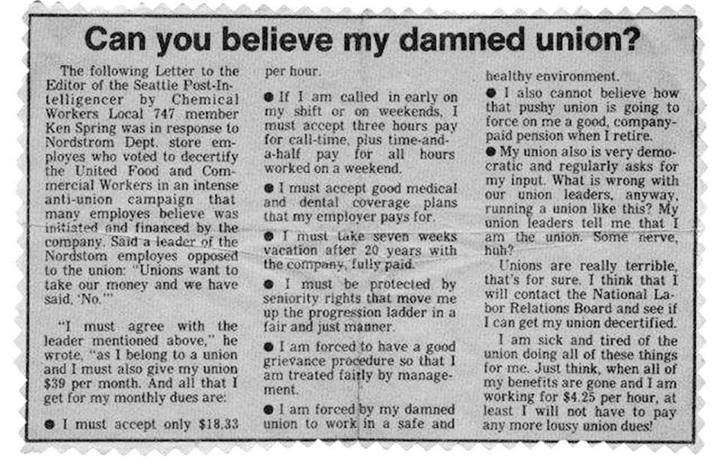
One of the most important aspects of the relationship between labor and management is the way that workplace rules and compensation are established.  A contract that is negotiated between equals demonstrates the shared interests and respect between the two parties.  A handbook, or other mandated guidelines, no matter how "friendly in tone" represent an unequal relationship.  They are inherently unstable and create an atmosphere where workers are always vulnerable to changes and have few options for recourse if unfair or flawed policies are enacted.   

For decades, educators in Wisconsin worked with administrators and school boards to establish the rules for school workplaces.  With Act 10 that has changed drastically.  This legislation was enacted, not to improve education or to promote student success, but rather for political and economic gains for a small number of people.  Educators operating without contractual protections found themselves less able to speak out against "reforms" that are not always enacted with the best interest of students or families in mind. 

Here in Madison we have been able to keep our contract active (although with some significant changes) through strong membership, a supportive community and a school board/administration that has seen the value of maintaining the contractual relationship with staff.  This hasn't been easy, and the climate in our schools is not what it was prior to Act 10.  However, the contractual protections offered through our negotiated agreements has given Madison educators an opportunity to voice their opinions and act to promote the interests of their students.        

For those who argue that a union acts only to benefit their membership, even at the expense of our students, I offer this reminder of what a union can do.  A couple of years ago MMSD administration tried to change elementary educators planning times so that we would have the half-hour before school as planning time.  This meant that we would begin our contractual day 30 minutes prior to school starting and end our day 15 minutes after dismissal.  MTI members rose en masse against this plan because it would weaken our ability to communicate with families and present a danger to students.  We often have to help students at the end of the day and busses are late, etc.  Because of the strong reaction and several hundred MTI members attending a school board meeting, the policy was never enacted.  I was reminded of this action by the union to protect our students on the first three days of school when we waited well over 15 minutes for busses to arrive after school.  If we hadn't had a contract at the time it is questionable whether so many educators would have been comfortable speaking out against a flawed policy. 


MTI's current contract with MMSD expires in June, 2014.  Members have been nervously awaiting news as to whether we will be negotiating a new contract before the Wisconsin Supreme Court takes (and votes 4-3 against MTI in all likelihood) the suit that MTI brought against the constitutionality of Act 10.
We got great news on Friday!!!!  


Education News…
Diversity- We've come a long way in our society in terms of race relations and desegregation.  However, we have a long way to go, and we are always in danger of slipping back to a time of segregation and division that we never want to repeat.  


Our schools, just like our society, are constantly struggling to provide the most opportunity for all in the most inclusive environment possible.  The "American Dream" is built on the idea that we are all equal and that anyone has the opportunity to succeed.  However, we know that this isn't, and hasn't, been true for all groups.  As a nation we have often failed to recognize and respect diversity in our citizens.    


The previous article has been hailed as an example of how charter schools are exclusionary and bigoted.  It is true that many charter schools enact policies that exclude students for a variety of reasons and that public schools operate with different expectations.  However, instead of focusing on the shortcomings of charter schools, we can also use this article as a reminder that those of us in the public schools recognize that we may create a similar atmosphere in our classrooms and schools.  We need to find ways to maintain positive learning environments, prepare our students for success in the future, and still create a school climate that values all students. 


Testing and Common Core- The controversies over Common Core continue to magnify.  I continue to be offended by the way that the implementation of the Common Core is presented to families.  Most of the information from school districts is focusing on how the Common Core will increase the "rigor" in our schools.  Yet, I don't believe that students in my classroom will be experiencing a sudden increase in the level of material, or in the academic challenges I pose this year.  Can I improve my practice? Of course I can, and I make every effort to do so every moment of every day.  Will Common Core and the new curricular materials I have available suddenly make me a better educator?  I don't believe so. 

bit.ly

Instead of improving my practice, the Common Core "reforms" will serve to decrease the funds that are available for me to be innovative and to provide the highest quality materials to my students.  


It will pad the pockets of a small number of "Educational Investors".  


It will mean more testing for my students.  We will spend the greater part of September gathering data that I will use during the few moments of teaching that I have before we test in October and November.  


Charter and Voucher Schools- All of these reforms will provide ammunition for those who want to increase the "choices" available for families.  They will point to the test scores and the increased standardization of curriculum as a reason to support the innovative methods and "successes" of the private school system.  A private school system that is increasingly using public money and that hasn't proven to be any more successful than the public schools (and often less successful).  


Is all this a reason to abandon hope?  NO!  Instead these challenges provide us with even more motivation to share information, promote our schools and work to defend public education. 


Sunday, September 1, 2013

#128- Labor Day Issue, Singing and Politics


Keep Labor in Labor Day!!!…
For many Americans the reason we celebrate Labor Day has been forgotten.  For many it has become the unofficial end of summer, just a three day weekend before the school year really gets underway.  Even more troubling are the commentaries that will speak about the historical achievements of labor while at the same time implying that the need for workers to organize is just that, historical. 


There is no doubt that organized labor in America has a rich history that should be celebrated.  The economic power of America has been built on the backs of the working and middle class, and the working and middle class owe a large measure of their successes to organized labor.  We can use Labor Day to celebrate these achievements.       


However, to view Labor Day as a day only of revisiting the history of the movement is to ignore the real need for continuing efforts to defend the rights of workers.  Organized labor is not the dinosaur from the past that those who attack worker's rights in modern America would have us believe it is.  In fact, in the current climate, the need for workers to organize is every bit as important as it ever has been. 

We are seeing a concentration of wealth and power in the hands of a small number of people that threatens the very fabric of our society.  This isn't something new in our history.  The very wealthy have always sought to dominate our society and to cement their status through a variety of political, social and economic efforts.  In the face of these efforts, organized labor has often been the sole voice that has protected the majority of citizens and served as a balancing force against the power of the few. 


The current climate for workers is troubling.  Low pay, cuts in hours, reduced or non-existent benefits and an increasingly hostile political climate are putting significant pressure on employees in all fields.  The past decades have seen a gradual erosion in the power that unions are able to exert and an, all too frequent belief, that the need for unions is gone.  After all, we have laws to protect workers and other policies that insure workplaces are safe and fair treatment for employees is guaranteed, right?

The reality for many workers is that they are facing significant workplace challenges and that the working conditions for workers have degenerated.  Places like Wal-Mart that used to be more worker friendly are now anything but that.  Workers are told that they should feel lucky to just have a job, and that any dissent or effort to improve their conditions will not be tolerated.  Once again, this isn't anything new to our nation.  In challenging economic times we have always seen the wealthy use this strategy of controlling the labor force by pitting workers against each other and using the "market" to drive down wages, benefits and working conditions.  Individual workers struggle to be heard, but organized workers have a voice that is more powerful.    


We certainly can't rely on politicians to protect the workers of our society.  In Wisconsin this fact has been made crystal clear over the past couple of years.  The idea that public policy is designed to promote and protect the rights of workers is so far removed from the reality as to be laughable.  The "focus" on jobs is simply political rhetoric designed to garner the support of voters, but has no real substance to it.    

www.wjfw.com

The attacks on worker's rights extend to all types of employment.  The attacks on public employee rights to organize, are the latest in the efforts to dismantle organized labor in America.  A significant amount of energy has been put into creating the illusion that public employees, like educators, don't need organized labor to protect their interests.  Even individuals speaking publically in support of  public educators question their need to be involved in labor issues.
  
"Teachers have not always helped themselves, due in large part to occasional periods of what look like out of touch labor militancy."

Educator unions and the actions of their members are not "out of touch labor militancy".  The collective bargaining agreements that have been negotiated over the years allow educators to focus on doing their jobs and advocating for the students they serve.  They are an effort by employees to exercise some measure of control over their working conditions and benefits.  Anyone who denies this needs only to look to school districts across the state and nation where union protections have either been weakened or eliminated.   


www.cpr.org

There is a clear effort to de-professionalize education and to turn the field into a stepping stone to a "real" career.  The combination of eliminating incentives and protections provided by negotiated contracts with the wave of educational "reforms" creates an attitude of disrespect for professional educators.  Despite significant evidence that educational outcomes for students are improved by educator stability the rhetoric of reform puts more faith in programs than in educators.    


The budget crisis that was manufactured to create the "need" to attack public employee bargaining rights also has allowed for Wisconsin Republicans to enact state budgets that will perpetuate the perception that public employees are to blame for the economic woes in Wisconsin.  By cutting state funding to school districts, these districts are forced to increase property taxes.  This literal passing the buck, increases public sentiment against educators and school districts.  


The politics of "divide and conquer" are obviously being used here in Wisconsin.  It is being employed to pit different groups against each other.  Those who employ these strategies hope that the citizens of Wisconsin forget that we all have an interest in the success of every laborer.  A strong, healthy society is built on the belief that every citizen is valued and every job is important.  They hope to continue to deceive the citizenry that they are acting on behalf of the majority.  On Labor Day we need to remember and celebrate our history, but also look to the future.  A future that must include a place for organized labor at the table. 

How unions help all workers | Economic Policy Institute

www.epi.org/publication/briefingpapers_bp143/

How unions help all workers | Economic Policy Institute

www.epi.org/publication/briefingpapers_bp143/


Solidarity Sing…
Bizarre and disturbing are two adjectives that somewhat adequately describe the past week at the Wisconsin State Capitol. 
It was a week where we were reminded that just a year ago the Wisconsin Senate unanimously honored the Solidarity Sing Along.

It was a week where the fear that we would see violence in our capitol was realized.  That this violence came from law enforcement is extremely troubling to say the least. 


We are seeing continuing issues around the applications for permits.  Sometimes supposedly on the "behalf" of the Solidarity Sing.  Some wonder if this isn't an attempt by the administration to defuse the situation without conceding defeat.  


It was also a week of  hope and solidarity.  We are reminded of the violations of our rights and the need to continue the struggle.


www.isthmus.com

www.cityofmadison.com


How will this struggle be resolved?  What will the eventual outcome be?  The answers are not clear and the end of the conflict is not yet visible.  However, it is clear that the Solidarity Sing will continue to be a voice in Wisconsin despite the efforts of the administration to suppress it. 
Wisconsin Politics…
Anyone who thought that the political battles in Wisconsin were behind us is sorely mistaken.  If anything the conflicts here will only escalate in the immediate future.  The stakes are extremely high for all of us who are interested in returning Wisconsin to a progressive and socially just path. 

If anyone needed evidence that we need to continue to work to change the course that our current leadership is taking us in.  A few examples of corruption, questionable ethics and dubious motives. . .

dnr.wi.gov


Governor Walker is clearly in campaign mode (as if he hasn't been campaigning since Day 1 of his tenure in office).  Whether for another term as governor, or aiming for a higher office is a reasonable question.

www.wkow.com

Absolutely love the quote from this article, “'Campaign' refers to Walker’s 2014 re-election bid, although it is unclear how many Wisconsin voters will be in Seattle next week.”

blogs.seattletimes.com


 80% insurance rate hike under ACA will take four years - Milwaukee -...

Along the way we will need to work to combat the intentional ignorance that so many in our society seem to enjoy, and that is perpetuated by major media outlets.  


We must to begin mobilizing and preparing to defeat Walker in 2014.  This begins with finding a candidate that will truly represent us and can generate statewide support.