Sunday, November 3, 2013

#137- Educator Morale


The Beatings Will Continue
Until Morale Improves. . .
Public educator morale is low.  We hear this all the time from a variety of sources, and those of us in the field of education hear it, know it and live it on a daily basis.  Low educator morale isn't a new phenomena, but the dropping spirits of educators are accelerating at an alarming rate.  Concerns about losing collective bargaining rights, increased pressure from evaluations, and an increasingly hostile climate all add to the existing stresses that educators face.   


Yet, there are many who question the need for concern about educator morale.  After all, to many, education is just another profession and educators should be able to handle the same stresses and challenges that any other employee faces.  We hear this sentiment expressed all the time.  When educator morale is mentioned the conversation inevitably turns to the long summers off, the short hours, the fact that those in the private sector have been suffering more for longer periods of time, etc.  The question comes up, why shouldn't those educators be treated like all the rest of America's workforce?  After all, it's not like they have a tough demanding job.  The hours are short, the pay is good, and those benefits, wow!  Even those sympathetic to educators and supportive of our public schools frequently take this tone.  I often hear people say, I support my kid's teachers, but. . .     

In addition to the comments about pay, working conditions and benefits, talk inevitably turns to the quality of the American public education system.  Test scores, employer concerns, and anecdotal evidence of the failure of our schools is used to essentially say that public school educators don't earn their paychecks anyway.  We should ignore the realities that educators work in, the challenges our students face, the society we live in, and the validity of the assessments used to evaluate schools.  Just look at the bottom line, that's what we do in the private sector right?  Education should be treated as a business, and educators are just like any other employee in any other industry.  Morale should be secondary to productivity is the thinking of many.

This flawed logic is having an incredibly harmful impact on our nation's schools.  While the argument that employee morale in any industry or profession is important and that "happy" workers make for better productivity, the reality is that educators do their jobs in a profession that is very different from much of the rest of the workforce.  We are not "better" and we are not "more privileged" or "more deserving", we simply do a job that requires a specific set of skills and a particular emotional approach in order to successfully carry out our responsibilities.

The heart of the issue lies in the reality that the "products" produced in the "educational industry" are the knowledge, skills and attitudes of our nation's children.  This is very different from a physical product or even a service that employees in other professions create or deliver.  A professional educator designs the curriculum, delivers the instruction and sets the tone for the environment that the students work and socialize in.  Our "customers" are our "products" at the same time.  The "raw materials" we work to mold into a finished "product" (a well educated, career and college ready citizen) come to us with a variety of strengths and challenges, they operate in a society filled with preconceived ideas about them.  In a public school every student's needs must be addressed and no one can be turned away.  As educators we accept these challenges and do our best to create a learning environment that is positive, supportive and filled with opportunity. 


In order to do this challenging task well, educators need to be sound not only in their knowledge, but also in their emotional state.  We have to be ready to calm a frightened or angry student, support a family in crisis, help solve the social problems of students and provide an education all at the same time.  If morale is low, then these multiple challenges become simply overwhelming. 

Our morale is low, not because we have been coddled for too long.  It is low, not because we couldn't handle it in the private sector so we turned to public education as an easy way to make a buck.  It is low, not because we don't want to work hard to help our students.  It isn't low because we don't want to be held accountable for our student's achievement.  It is low for a number of sound reasons. 

Lack of respect- We have all heard these lines (or some variation of them) "Those who can do, do.  Those who can't do, teach."  Sitting in a professional development last week I watched a video (made by an educator with a pro-education message) say that teaching "isn't rocket science."  There is a general sense among many that teaching students is tough, not because of the skills required, but rather because of other intangible reasons.  Somehow the skills required to teach 25 students of different backgrounds, abilities and motivations a concept is devalued in our society.  Educators aren't skilled professionals, but rather glorified babysitters who simply give out information to students that the students really could get anywhere. 

Actually, it is true, teaching isn't "rocket science".  It isn't "brain surgery" either.  Educating students is a unique combination of technical skill combined with an ability to motivate students while understanding their basic needs and addressing their emotional health.  Education is a form of art.  Just like any art form it is easy to say what to do and how to do it, but a totally different thing to actually accomplish.  In devaluing educator's skills we use the flawed logic that anyone can paint a masterpiece, compose a musical score or wow the crowd with an electrifying athletic move simply by following a set of directions or trying hard.

Educators take great pride in our ability to perform a demanding job.  Saying that our skills are less than those in other professions and are not worthy of respect is a direct attack on us and our value to society.


Devaluing educators and education- Once the professional skills of educators are questioned, it isn't too hard to begin arguing that they don't deserve to be respected or compensated at the same level as other professionals.  Sentiments like this one from the comment section of an article about educator morale sum up the disrespect shown directly to elementary educators.    

"Don't get me wrong, I have no problem with that sort of salary ($73k/year) for a teacher who teaches higher level subjects...but there is no reason for an elementary school teacher to make anywhere near that amount."

However, the reality is that $73k/year isn't a salary that compares to other professions that require the same expertise and education.  For that reason it really disrespectful to all educators.  Would a professional actor, athlete or CEO work for that amount of money? 

Here in Wisconsin we are still reeling from the impacts of Act 10 and other "reforms" that have been directly aimed at educators and education.  It is difficult to feel valued when my families take home pay for the last month was over $700 less than in previous years.  That this can occur in my state with a long history of supporting public schools certainly doesn't help the morale of educators. 

Creating an intimidating and unfriendly environment- The decline in morale over the past couple of years can be directly traced to the changes in working conditions brought on by new legislation and policy.  These are supposedly designed to make our schools more "efficient" and more "accountable".  Yet, the legacy of policies like No Child Left Behind and Race to the Top is not increased student achievement, but rather an environment that is hostile to learning and reduced opportunity for students.  


The loss of collective bargaining rights for most educators, and the restrictions on bargaining that exist for those who do still have contracts create unfavorable working conditions for educators.  The movement to make educators more "accountable" has caused many to question whether our employers trust us to use our time well.  We are increasingly required to document how we use our time and to participate in mandated professional development instead of planning or collaborating with our colleagues to meet our student's needs.      


This environment isn't just unfriendly to educators, but is unfriendly to public schools in general.  The entire voucher movement arises out of a climate that is hostile to public education.  The idea that our public schools deserve our respect and support is foreign to many in public office and their ideas fuel negative public opinions.  


Implementing harmful "reforms"- While working conditions, compensation and the general climate surrounding education are important to educators, it is often our inability to do our jobs in the way we feel that is best for our students that causes significant stress for us.  We are seeing a disturbing movement in education right now towards "rigor" and "accountability".  These trends aren't disturbing to educators because we don't want to challenge our students or be accountable.  They are troubling because the "rigor" and "accountability" that is currently being imposed on us appears to be misguided and harmful to our students. 


At the end of the day most educators that I know put their students needs ahead of their own in almost every way.  It is because of this that we put in the extra time to meet with students and their families, that we attend events in the community and that we speak out about so called "reforms".  We provide snacks on a daily basis for hungry students, we pay for field trips for students who can't afford them, we provide school supplies.  We offer encouragement and emotional support above and beyond what is required of us.  We look for ways to help students achieve the standards and benchmarks while still retaining a love of learning. 


Our reward for these efforts is continuing professional development calling for us to either completely scrap our existing curricula or to learn new terms for things that we already do.  We are asked to collect data on our students to be used to fuel more changes.  We must change our schedules to implement programs that have little impact on student achievement.  We are pressured to pressure our students and make them view learning as a chore or obligation.  Learning becomes something measurable and a requirement instead of an opportunity and a joy.  The means becomes more important than the ends.  We spend more time justifying ourselves and worrying about data than we do preparing lessons to engage our students in learning.  In the end it is the children who suffer because of the policies that are implemented.          


None of what I've written so far is likely to change the opinions of those who truly believe that our current state of education is moving us in the proper direction.  The thinking that schools should be run like businesses and educators need to simply deal with that or leave the profession is a difficult mindset to change.  The only way to really understand what is happening to our public educators is to experience what we are experiencing and talk directly to people who work in our schools.  All of the data, all of the test scores and all of the anecdotal evidence can't compare to real life experience. 
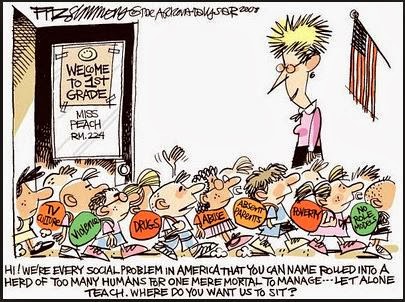

The real problems in education aren't the public educators and they aren't the students or families who attend our public schools.  The problems lie in our continuing political and economic battles.  Our schools are caught in the crossfire between powerful groups who seek to maintain and expand their hold on wealth and power.  Our students suffer, not because of the educators who work with them, but because of policies enacted from people outside of the schools.  


Our students, educators and school suffer because we as a society, haven't ever committed to making our schools work for all students.  We are quick to assess blame, but not as quick to work towards solutions that will effectively address our challenges.  It is one thing to point fingers of blame, but another to put your hands to work fixing the problems that we all know exist in our schools and in our society.       

Educators feel helpless in the face of these attacks and unable to do what they feel is correct for their students and their profession.  They feel disrespected and devalued.  We don't have many friends in high places who advocate for us on policy issues.  Most of those with access to power are aligned with the "reformers" and the educational profiteers.  It is a recipe for low morale, high-turnover and dissatisfaction among employees who are so vital for the future of our students and our society.  We need to start changing the ingredients in our "educational menu" so that we can  make positive change happen for our students, our educators and our public schools.           
      
www.wasbmemberservices.org

Sunday, October 27, 2013

#136 October 27, 2013- Education Reform, Labor News and Politics


Education Reform- A Tool or a Weapon?. . .
Caring for and educating our children is one of the most important things that any society can do.  When done equitably, rationally and positively education creates opportunities and hope for the future.  When done poorly or with questionable intentions our system of education can serve to institutionalize inequities and limit opportunities.  In doing so we not only harm our nation's "bottom line" by reducing the potential for innovation and economic success of future generations, but we also create a society that fails to live up to the language of its founding documents. 


If America is ever to truly live up to the lofty goals of freedom, opportunity and equality that we claim to aspire to, we must provide every child with an opportunity to make the most of their skills and abilities.  In short, education is the cornerstone of a true democratic republic.  As Thomas Jefferson wrote in 1786,  "I think by far the most important bill in our whole code is that for the diffusion of knowledge among the people. No other sure foundation can be devised, for the preservation of freedom and happiness...Preach, my dear Sir, a crusade against ignorance; establish & improve the law for educating the common people. Let our countrymen know that the people alone can protect us against these evils [tyranny, oppression, etc.] and that the tax which will be paid for this purpose is not more than the thousandth part of what will be paid to kings, priests and nobles who will rise up among us if we leave the people in ignorance." 


As a nation, our struggles to educate our young people mirror our struggles as a society.  We've seen our schools be visible reminders of segregation.  We've seen our schools used to eradicate cultural differences in brutal and inequitable ways.  We've seen our schools perpetuate deep divisions and offer "separate and unequal" services to our students and communities.  We've also seen them become visible symbols of hope for a better future.  Our schools have been a measuring stick for our society's efforts to provide for all of its citizens. 


The efforts to educate our students equitably has been, and will continue to be a double edged sword that can be wielded as a tool for reforming our society, or as a weapon to perpetuate the inequities in our political, social and economic systems.  On one hand we see committed educators and supporters of our schools working to try and do things in new and improved ways.  We see efforts made to take what is working in our schools and expand on these things.  We see new and innovative uses of technology combined with tried and true methods of inspiring and educating students.  Schools are providing needed supports and services to students and families and are uniting communities around the hope for a better tomorrow. 

On the other hand we see a concerted effort to continue the use of education as a "divider" not a "uniter".  Whether by igniting a war against educators and public education through attacks on collective bargaining, constant efforts to undermine confidence in our public schools or efforts to privatize our schools, there is clearly a group of people who don't see the power of education as one that should be shared among all members of our society.  For these people, the "American Dream" isn't one of equal opportunity, but rather one of holding on to power and wealth even at the expense of entire segments of our population. 

In any conflict it is important to know who your allies and opponents are.  In the battles around education reform these lines are sometimes difficult to identify.  There are many people who are truly interested in improving our schools and who have been working tirelessly to find ways to make our system of public education better and more equitable.  At the same time, there are those who use the language of "reform", but who are pushing education "reform" for less than pure reasons (profit, political power or other ulterior motives).  Too often, those in the latter group are well connected, wealthy and powerful.  They are the ones whose voices are heard most often in the public debate over education.  The voices of the educators and those who work in our schools is muted by the unequal financial capital, limited access to decision makers and less public visibility that limits the audience for our message.   


These inequities in power mean that the discussions and debates around our public schools is shaped by a small group of individuals who control the direction that our educational legislation and policy making take.  The language that we use, the tone of the discussions and the climate that we educate our students in is shaped by these, small number, of groups and individuals.  The Common Core State Standards are an example of what happens as "reforms" are offered and implemented.  Without debating the standards themselves, there is a definite problem with the way that they are being used in creating curriculum and programming in our schools.    
       

It is in the materials, curriculum and resources that are available to educators that we see the true harm of the "reforms" offered by these supposed allies of public education.  A small number of individuals, companies and organizations are behind most of the products and services that are being sold to school districts.  This has been made very clear to me over the past few years as I have researched the companies and foundations that provide materials that MMSD educators are given during professional development sessions.  The materials we use are frequently sold to us by groups that support the privatization of our schools. 


www.edweek.org
The end result of this connection between "reformers" and "educational profiteers" is that educators are now fighting against the forces that seek to destroy our profession even in our own staff meetings and professional development.  MMSD staff was given an article about the CCSS in our most recent professional development that gave thanks to the Bill and Melinda Gates Foundation, a group that has done so much to undermine our public school systems across America.  The article seemed to be about ways to implement changes in reading instruction, but didn't miss an opportunity to criticize our past efforts and further the opinion that the new ways of educating students will magically fix our problems.  New ways that have products and programs available for purchase.

The reality that many of the so called "reformers" don't want people to know is that most of their products are repackaged ideas that educators have been using for a long time.  While there is no doubt that we can continue to improve our methods of teaching, the fact that we already have qualified professionals with a wealth of knowledge and skill in our schools shouldn't be ignored.  The efforts of professionals in our schools are being limited by the increased amount of time taken to administer assessments and learn supposedly new ways of teaching.  We are told that we need to improve our practices by doing things that we are already doing.  


www.huffingtonpost.com


Whether placebo (CCSS) or poison pill (privatization and testing), the prescription leads to the same result unless public educators and their supporters are able to change the current educational trends.   As many top authors expressed in a letter to President Obama recently, "We are alarmed at the negative impact of excessive school testing mandates, including your administration’s own initiatives, on children’s love of reading and literature. Recent policy changes by your Administration have not lowered the stakes. On the contrary, requirements to evaluate teachers on student test scores impose more standardized exams and crowd out exploration." 


unitedoptout.com


Labor News. . .
Recent news from the ongoing struggles around worker's rights. . . 
While the effect may be short lived, public sector unions in Wisconsin won a victory in the courts as WERC was found to be in contempt for ignoring Judge Colas' ruling.  

host.madison.com


Madison educators were able to negotiate a contract for the 2014-15 school year, but the confusing legal situation continues to cause uncertainty and anxiety for us.  

pubinfoweb.madison.k12.wi.us

Of course the assault on the rights of employees in the workplace shows no signs of slowing down either locally, or nationally.  


Political News. . .
The struggle over the government shutdown has ended with the Democrats emerging on top, Republicans are concerned about the upcoming 2014 elections and the economy is continuing to show signs of recovery, yet the mood among Progressives is still apprehensive and cautious.  One of the major reasons for this is the fact that with all of the positive news, the debates on issues of importance are still being framed by Conservatives.  Whether it is education reform, economic policy or issues like electoral reform, the discussions still begin with austerity, anti-government rhetoric and other Conservative talking points. 


Despite their recent defeats and questionable track record Republicans are gathering strength to fight another day.  Here in Wisconsin they control all branches of government and are working to set the tone for the 2014 races that will be vitally important on both state and national levels.  This means that there will be a concerted effort to portray Governor Walker's policies in a positive light.  A couple of examples. . .


Despite record cuts in state aid for schools, the headlines give the impression that schools are receiving more aid from the state.  The increase in aid in the current budget doesn't offset the cuts in the previous budget.      

host.madison.com

Walker and the GOP will attempt to portray any problems with the ACA and healthcare issues as the fault of Democrats.  They will try to ignore and cover up their own efforts to make the system fail.

host.madison.com

Property tax relief will become a political tool to bolster Walker's claim that he is looking out for the taxpayer.  Yet, the small gains for individual taxpayers are part of a plan that gives landlords and large property owners more relief.  The claim that property taxes have gone down because of Walker's policies also ignore the reality that in many cases, the reason for lower taxes is lower property values.  


Progressives in Wisconsin are hoping that the Democrats will be able to put a candidate against Walker who can not only win the race, but represent our values once elected.  Values that include public schools, equitable policies and a restoration of collective bargaining rights for all workers. 


My family and I have been enjoying the TV show The Walking Dead, and I have been reading some of the books that are set in the world of the show.  This quote from The Walking Dead: The Road to Woodbury caught my attention.  While the Walker in the quote refers to flesh eating zombies, not our governor, the message still resonated with me.

". . .This is how the world ends not with a bang but with a Walker, a constant reminder of the end of society and government services as we know them." 

Sunday, October 20, 2013

#135 October 20, 2013- Battles in Politics and Education


Getting Ready for the
Next Battle. . .
With the end of the recent standoff in Washington D.C., many around the nation breathed a sigh of relief and moved on.  In fact, this is exactly what those responsible for giving us the recent crisis would like to have happen.  The most extreme members of Congress and their supporters don't want the public to remember their words and deeds over the past couple of weeks.  Instead, they hope that the ACA will fail miserably and that the public will focus attention on that, not their own divisive, inequitable and unsustainable policies and beliefs.    


What exactly did the extreme conservative faction of the Republican Party do that should cause all citizens to be concerned?  They changed the rules of House to limit the ability of members of Congress to call for a vote on the shutdown.  This limitation of power extended to all members of Congress except for a select few.  They took our nation to the brink of the economic unknown.  They further divided a nation that is already struggling to find reasonable ways to resolve our differences.  That they did all this for what really appears to be a combination of political vindictiveness and short sighted political gains makes it all the more problematic.      


Wondering how your elected representatives voted?   


What was made crystal clear during the recent conflict in D.C., and what should be obvious to anyone living in a battleground state like Wisconsin, is that this recent defeat for the radical members of the GOP isn't the end of their efforts to undermine our system of government.  In many ways the defeat will only fuel the fire of the most extreme members of this faction.  The most terrifying side to this is that, instead of admitting defeat and trying to make our system work for the majority, these radicals will return to their demographically isolated enclaves and create schemes to destabilize our democracy.  


Wisconsin is gearing up for our next political struggle.  The next election will help determine what direction our state will move in, as well as be a benchmark for the nation.  We are already seeing significant interest on a national level in the upcoming race for governor and Congress.  Wisconsin's Congressional delegation was divided along party lines in voting to end the shutdown.  In 2014 we have a chance to make a real change in current political trends.


Wisconsinites also have an opportunity to determine what kind of society we want to live in.  Too often politics and elections offer relatively similar candidates with ideologies that are too similar to really provide significant choices.  The argument that a moderate Democrat and a moderate Republican are virtually the same candidate isn't too far off the mark.  Yet, the current brand of Republican candidate pushes the debate far to the right.  The strategies, philosophy and policies that these candidates support put an emphasis on money and power, while pushing quality of life and opportunity for all out of the debate.  


We will see and hear lots of claims that the conservative agenda here in Wisconsin has improved our state's economic outlook, its political functioning, and made Wisconsin a better place overall.  However, there is another side to the "facts" and figures that the Republican Party of Wisconsin will either ignore or attempt to hide.  


An example of this is the ongoing debate over tax relief and the efforts of the GOP to help the middle class.  They have framed the debate so that it appears that there will be some relief for taxpayers, and created a situation where a vote against their proposal will appear to be a vote for higher taxes.  Yet, the property tax relief that is proposed is more beneficial for wealthy residents and large scale property owners.  Ignored in the debate is the potential increase in property taxes due to an inequitable school funding formula and cuts in state aid to public schools.  School districts across Wisconsin face the potential need to increase their tax levies to meet the needs of students.  This provides fodder for more attacks on our public schools and the high cost of educating our students, when the reality is that the state isn't meeting its Constitutional obligations regarding public education.    


Also ignored are other ways to help families meet the costs of higher education.  


Education Reform, Why We Need It and Why We Need to Fight It. . .
Reform has become a controversial and often despised word for public educators.  We face a continuing onslaught of "reforms" that come from outside our schools, are promoted by "experts" with few real educational credentials, and that do little to help the students who need the most support.  


These "reforms" change the way we teach and impact the daily experiences that our students have in schools.  Testing, interventions, core instruction and a constant pressure to implement new curricula so that students are "rigorously" challenged to develop new skills, all have a significant impact on our students and our schools.  Educators are told that every minute of every day must be applied to activities that will produce measurable results.  Too often ignoring that we may not be able to measure the most valuable skills students learn, or that 9 year olds are not factory employees.  Note #2 on the following list.


We spend so much time collecting data and evaluating our practices based on measurable statistics that we ignore the humanity that is the children we are educating.  School Improvement Plans in the Madison schools are reduced to improving student's test scores, ignoring school climate and student engagement.  Students lose opportunities to study science, social studies and the arts so that they can receive extra instruction in literacy and math.  Yet, this extra instruction doesn't seem to impact their achievement, and reduces their love of learning.  Specialists like school social workers, psychologists, bi-lingual educators and others are taken away from students to help with assessments.  The monster of data that has been created is quickly devouring students and schools.     


The phrase stating that there are, "Lies, damned lies, and statistics" applies directly to education in today's America.  Statistics are thrown around in discussions about our schools, but they are often misleading and frequently self serving.   
 

We even see our need for data impact national foreign policy as we seek evidence that deaths of innocents caused by drones may, or may not increase the allure of terrorist organizations.  This debate ignores the reality that killing citizens of other countries shouldn't be acceptable whether it fuels terrorism or not.   


Reform shouldn't be a "bad" word for educators.  In fact, we need reform now, more than ever.  The divide between the "haves" and the "have nots" in our society is widening.  The gaps that exist in income, social status and political influence are mirrored in our schools.  Our society is becoming more segregated and less equitable as these gaps widen. 


Our public schools could be a vehicle to address the inequities in our society and potentially provide the "tools" necessary to make significant, positive change.  Yet, we are mired in a constant struggle to simply maintain what we currently have.  We engage in debates over details, but don't impact the larger picture.  We are creating an educational climate that will only increase the gaps that exist.  Students from poverty, students from different cultures and students with exceptional needs have been failing in our system, and they will continue to fail unless we act to make real change happen. 

These efforts to resist "reform" are often portrayed in one of two ways by "reformers".  One view is that fighting school reform is part of a series of radical, liberal attempts to indoctrinate the youth of America into Socialist ways of thinking.  Schools are Liberal hotbeds of educators plotting to overthrow all that is "good" in America.  The second view is that the resistance to "reform" represents the efforts of educators and their unions to hold on to the status quo that fills their pockets and fuels their political efforts.  By forcing educators who disagree with testing, standardization of curriculum and other "reforms" into one of these two camps education "reformers" can portray them as radicals and out of touch with what the public wants for education.    

Too many educators simply give in to the demands that are placed on us.  The loss of union protections and collective bargaining agreements weakens our ability to resist.  The vast scope of the attacks leaves us frustrated and without the time and energy necessary to resist.  We face public opinion that has been shaped by the fallacies and misleading statistics from those who seek to "reform" our schools.  We receive policies shaped by leaders who don't live and work in the same schools that we do.  They see numbers and we see families and students.

We do need to reform our schools in some ways.  However, the reforms that we need are not the ones that we are currently implementing.  Those "reforms" come from people who are outside the system, and who far too often don't even send their children to the schools they create policy for.  Those "reforms" are driven by business and economic interests and don't provide opportunity for all students to access the skills that are needed to be successful entrepreneurs, scientists and leaders.        


Instead of going along with the current "reform" movement in education, educators, public and private, need to make a stand for their students, their families and their profession.  We are professionals and we work on a daily basis with our students.  We need to make connections with our families, our community and those in policy making positions to insure that all voices are heard.  We need to unite and support each other in our efforts to meet the real needs of our students, not the needs of business and lobbyists.   

This is a national debate, but one that plays out in the personal lives of millions of children in our nation.  It is a debate that we must win.  All students deserve an educational experience that is enriching, engaging and that opens the doors to a brighter future.