Sunday, September 16, 2012

Issue #79 September 16, 2012- Chicago to Madison, A United Fight


What This Is…
Issue #79- September 16, 2012
In this issue: The Struggle Continues

Defending Freedom…
People involved in the struggles here in Wisconsin have been justifiably proud of their efforts and feel that we are at the forefront of the fight to defend the freedoms and liberties that have been earned by our predecessors.  However, I often hear that we can't compare the struggles in Wisconsin to those going on around the world because of the difference in levels of physical danger that we face here compared to places like Egypt for example.  In other words, the validity of the struggle is based on the likelihood of death, incarceration or other trauma being inflicted on those involved. 

What these naysayers are forgetting is that we are seeing an erosion of rights that people have fought, bled and died for in the not so distant past.  There are a litany of heroes who have struggled for the rights of workers, voting rights and other freedoms that American citizens now enjoy.  We can't ignore the fact that any step backwards returns us to the conditions that caused the strife and violence that moved us forward.  We can't afford to simply accept what is happening here in Wisconsin and elsewhere in America without resisting the push to centralize power and to eliminate the rights of common people to express their opinions in ways that are protected by our Constitution (state and national).

Do people really need to see Americans physically harmed, illegally arrested, or even killed on our own streets to accept the fight as a valid and important one?  Are we willing to simply tolerate the efforts of the Walker administration to eliminate opposition by administrative decree and intimidation?  We see our society regressing toward a day when only an elite few had power and the remaining masses were subject to their control.  These abuses of power are exactly what those heroes of history fought against and it is up to us to continue the fight.      

www.progressive.org


Here in Wisconsin we continue the fight on the streets, in the political arena, in our daily lives and also in the legal world.  With all the legal maneuvering and stalling tactics one thing remains clear, if you have enough money and political capital you fare much better in the courts.  However, we can all hope that justice will eventually be done.  
 
www.jsonline.com

There is an obvious disconnect between our political elite and the rest of the citizens of this nation.

www.salon.com

CTU + MTI  + All Of Us= Their Fight IS Our Fight…
Human events and issues are complex, interconnected and rooted in social and historical contexts.  Because of this, most are rarely as simple as they seem, or as easy to explain as our political leaders and the media would like us to believe.  Finding the perfect slogan may work for a political campaign, but that slogan can rarely be turned into a coherent, positive policy without some adaptations and compromises.  We are seeing this quite clearly as our government stalls and is held hostage by a group of single-minded, uncompromising elected officials who refuse to give any ground from there extreme positions.  Positions which have led to significant strife in the past and which don't appear to have changed much over the years. 

The efforts to simplify complex issues lead to a narrowing of perspective that limits our ability to find solutions to the problems that we face.  In fact many of us are uncomfortable with the complexity that human activities bring and there is security and comfort in the "quick fix" or in following a "strong leader".  It seems like most citizens are willing to rely on small pieces of information from sources that they find agreeable to their own beliefs and rarely look at the bigger picture or try to uncover a larger truth that may exist outside their comfort zone.      
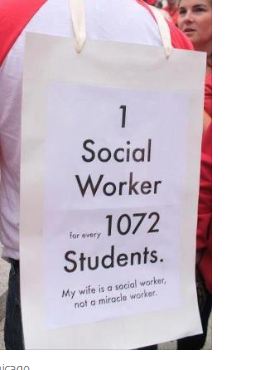

If you look carefully at the issues that surround recent events in Wisconsin, and that are also at the forefront of the labor conflict involving public educators in Chicago it becomes clear that we are looking at a struggle that is at a deep, fundamental level of our society.  These are battles that have been waged throughout time and that get at the core questions about what American society should look like. 

Conservatives, their supporters and those who don't recognize the real issues that Chicago's educators are raising would have us believe that the strike is just about money and a desire to avoid accountability for the struggles of some public school students.  You can see this in nearly all the mainstream media coverage of the strike.  It is nearly impossible to find an article that doesn't give the average annual salary of a Chicago teacher, or the fact that they have a shorter work day than many school systems do.  Ignored are the too often abysmal conditions, highly challenging environments and the fact that many of Chicago's students are facing significant challenges outside of school.

In a struggle like the one facing Chicago educators many different issues combine to form an intricate and confusing web of tangled historical, political, economic and social strands.  It is all too easy for any individual to simply throw up their hands and walk away from the struggle.  We all have personal needs that make a prolonged battle difficult to maintain and it is also difficult to maintain a positive outlook as we wage a conflict over territory that has been fought over many times before. 

It is difficult to maintain morale in the face of seemingly unending challenges that are posed by groups and individuals who have more resources and connections than we do.  However, it is important that the citizens of Wisconsin continue the fight and lend their support to the educators of Chicago as well.  If we simply "mind our own business" then we allow ourselves to be divided and defeated, and a defeat will cost us, as well as future generations dearly. 

What are the issues that make the struggle in Wisconsin, Chicago, Michigan, Ohio and all across America so important?  They are many and they are connected, but all point towards conflicting views of what America can and should be.


Class Warfare
I heard a conservative Madison radio talk show host attacking Obama because the gap between the rich and the poor was at some of the highest levels in American history.  The fact that this was used by a conservative made almost made me laugh out loud, until I realized that this is a powerful political strategy that conservatives use effectively.  They attack areas of their opponent's strength to try and neutralize their own weakness. 

It is clear that conservative economic policies benefit the wealthy more than anyone else.  The evidence here in Wisconsin is clear. 


What does that have to do with events in Chicago and public education in general?  Maybe because public schools are the place that most of the poorest and most at-risk students reside.  By cutting public education and safety nets that support our poorest families, conservatives place more pressure on school systems and create a crisis in education that they can exploit.


Educators are being portrayed as part of the economic elite and being painted as villains who are holding poor children hostage.  Articles that emphasize the average wage of a Chicago teacher clearly are designed to drive this point home.  Yet, $75,000 a year isn't a number that is in the same economic class as those who stand to profit from privatizing schools.  Why compare a teacher's salary to the wages that student's families make and not compare what educators compensation is to an education CEO?


It's About Truly Supporting Public Education
Public education is a vital resource for our nation's long term health.  Very few of the  political elite understand this and even fewer truly support public education in a way that allows for it to thrive and provide for our neediest students.  Most politicians have fallen for the conservative talking points and support the reforms that actually damage our public education system.  


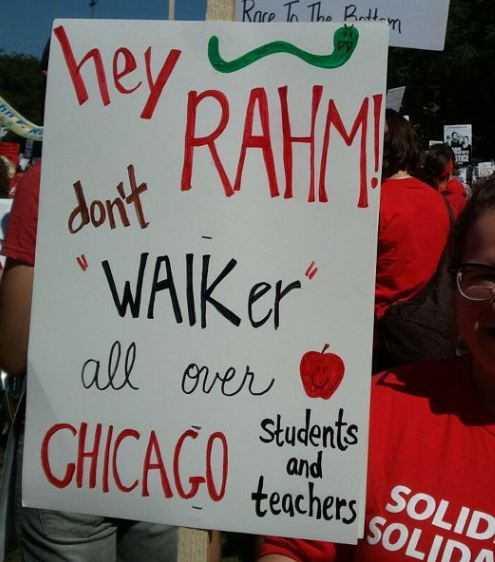
Rahm Emanuel has been a part of Obama's administration and reflects the views that have been expressed by both Democrats and Republicans alike.  In fact this quote about Emanuel could easily be said about Governor Walker or other conservative leaders.  "Emanuel will tell you that he knew what was wrong with Chicago's public schools and was determined to change it, because that's what strong leaders do."


Solidarity
The greatest strength of labor, the middle and working class lies in our solidarity and support for each other.  Divided, we have little power, but together we are strong.  Chicago's educators supported Wisconsin's fight and we need to return the favor.    


The Labor Movement is at a Pivotal Point
All the recent attacks on worker's rights have left labor reeling and on the defensive.  We can't continue to defend ourselves and face a losing battle unless we take the offensive.  We need to change the prevailing opinion of the general public and make them understand what the struggle is about.  Educators are probably the most potent force the labor movement has (based on unionized membership and the attacks from the right) and must step up their efforts to publicize the positive aspects of organized labor.  


Educator unions are unfairly portrayed as obstacles to reform when the reality is quite different.  Conservatives are using proxies like Juan Rangel, CEO of a profitable charter school chain- United Neighborhood Organization, to attack public educators.  


Education Reform as Weapon
The movement to "reform" public education is in reality a "back-door" method of destroying the system is supposedly "saves".  Chicago's educators are standing up for a view of education that goes beyond testing and other "reforms".  Class size, providing access to the arts, diversifying curriculum, providing services like nursing and social work in the schools are all issues that the CTU is promoting.  Without these services and programming it is difficult to see how students can receive an education that will serve them in their future lives.     


The director of the school where Rahm Emanuel sends his own children agrees with the Chicago public educators.  A couple of quotes from the following article…

"Physical education, world languages, libraries and the arts are not frills. They are an essential piece of a well-rounded education,” wrote University of Chicago Lab School Director David Magill on the school's website in February 2009.

Writing on the University of Chicago’s Lab School website two years ago, Magill noted, “Measuring outcomes through standardized testing and referring to those results as the evidence of learning and the bottom line is, in my opinion, misguided and, unfortunately, continues to be advocated under a new name and supported by the current [Obama] administration.”


Meanwhile, Here in Wisconsin…
While we turn our attention towards supporting educators in Chicago we face our own struggles at home.  A recent development gives us significant hope, but of course we know that the legal battles aren't over with this single ruling (on appeal we can probably assume what our state's Supreme Court will rule).  We have learned that it is only through our vigilance and action that we can maintain our rights.  We can celebrate now, but can't afford to think the struggle is over. 


There has been significant damage done to public school systems across the state that will be difficult to undo in the near future.  Restoring collective bargaining won't restore the cuts to education funding.  It is also tough to see exactly how to return different district's contracts to pre-Act 10 status.  Undoing a law that shouldn't have been done in the first place forces everyone (except for the guilty parties, Walker and the Republican legislators) to scramble and try to sort out the mess that they created.  I repeat the quote from a favorite author, Robin Hobb, who wrote, "Don't do what you can't undo until you've considered what you can't do once you've done it."  By creating an unfair law, and forcing school districts to implement it, Walker has set the stage for turmoil.  Turmoil that he will use a justification for keeping the law in place and to criticize the ruling.


Here in Madison, our school board is beginning to take on the issue of developing an employee handbook.  While the recent court ruling may impact the need for a handbook, the whole process has been enlightening for many union members.  We are beginning to see just how important our collective bargaining rights and the agreements that come from them really are.  Only public educators can effectively represent public educators and our students.  We can't allow others, even friendly others, to be our voice.     


Attacks on Education are Attacks on Educators…
No matter what the results of our struggles are, there has been significant damage done to the morale of public educators.  We have been blamed for our state's economic woes, called lazy and incompetent and seen a job that is an integral part of our identities devalued and maligned.  We have been told that we don't care about our students and that we don't want to be accountable for the work that we do.  Our economic survival has been threatened and many of us find ourselves struggling to make ends meet.  These attacks have been carried out on a personal level as well as on a larger scale and have impacted educators in countless ways.  We are left questioning ourselves and our profession.   


All of this has been done for a variety of reasons, not all of them out of malice.  Some "reformers" believe that they are actually improving public education.  Unfortunately, the results are often the same as the "for profit" reforms pushed by corporate interests. 

"TFA goals derive, in theory, from laudable—if misguided—impulses. But each, in practice, has demonstrated to be deeply problematic. TFA, suitably representative of the liberal education reform more generally, underwrites, intentionally or not, the conservative assumptions of the education reform movement: that teacher’s unions serve as barriers to quality education; that testing is the best way to assess quality education; that educating poor children is best done by institutionalizing them; that meritocracy is an end-in-itself; that social class is an unimportant variable in education reform; that education policy is best made by evading politics proper; and that faith in public school teachers is misplaced."


What we see is a continuing pattern where those in power attempt to "help" those who are not part of the decision making, powerful elite.  Instead of forming partnerships with each other groups those who have power force others to fit their "mold".  Educators often find themselves stuck between the different tiers of society and not a real part of either.  


It is so difficult to find products to purchase that come from companies that have policies that support human rights for all.  Yet, by asking companies to become more transparent in their interactions around the world we can at least see more of the connections that will allow us to make informed purchases that promote our values.  


Sunday, September 9, 2012

Issue #78 September 9, 2012- Church and State, Issue Updates


What This Is…
Issue #78- September 9, 2012
In this issue: Separating Church and State, Education, Politics and Labor Relations

Religion and Government…
There are two main topics that are "taboo" in polite conversation and since I've spent the better part of the past year discussing one of them (politics) I guess it's time to put in my two cents about the second (religion).  I should begin by being open and honest about my own background.  I was born and raised United Methodist.  Throughout my life I've had significant experiences with multiple religions through friends and associates as well as numerous experiences with individuals who are non or anti religious.  My life experiences, combined with my professional experiences as a public educator have shaped my personal beliefs about religion and its role in our society. 

However, all of this shouldn't really matter in our discussions about the issues that have been so important in our national consciousness over the past year, should it?  Remember, our Federal Constitution sets boundaries between our religious beliefs and the political system that sets the official rules that govern our interactions with each other.  The First Amendment opens by stating that, "Congress shall make no law respecting an establishment of religion, or prohibiting the free exercise thereof…"  Most Americans take this to mean that the "church" and the "state" are separated.  In fact, many of my students assume that these rules are so strict that we can't even talk about religion at all in class (try to teach history without mentioning religion). 

The misunderstandings that arise because of the "fact" that there is a Constitutional separation of church and state are problematic and frustrating as we try to deal with the issues that our society faces.  What most people don't realize is that the First Amendment has applied only to the federal government for most of our nation's history.  Some of the original states had established religions and continued to have them through the early 1800's.  It is only fairly recently that the Supreme Court began to interpret the First Amendment as a vehicle to restrict promotion of religion on a state level.  One example comes from a 1994 ruling where the majority opinion offered the thoughts that, "Government should not prefer one religion to another, or religion to irreligion."

Yet, it is incredibly difficult to separate religious beliefs and practices from cultural ones.  It is when we begin to look at how religious beliefs impact a group or individual's actions and interactions with other groups that government needs to become involved.  As a nation of vast diversity, the United States has long struggled with this challenge and tried to find ways to promote freedom, equality and opportunity without imposing a single set of religious beliefs on the whole nation. 

We find ourselves more and more being drawn into conflicts revolving around the moral compass of our nation.  These are conflicts that find their roots in misunderstandings of history and unnecessary antagonism between different religions.  There are many people who see our recent political, social and economic struggles as evidence that we are engaged in a war for the "soul" of America.  These people view our disagreements as more than just a debate about important issues, and instead see them as matters of greater significance.

I believe that they are failing to see the connections that most religions have  between each other and also the integration of political and religious thinking throughout human history.  Religions have long existed for multiple purposes.  They explained natural phenomena, they established the place of humans in the natural world, they set up rules to govern interactions between people and nations and they also allowed groups of people to establish shared beliefs that united them as distinct cultural entities. 

These explanations are in no way intended to minimize the role of God and the importance of a higher power in our lives.  However, when one looks at the wide variety of religions and the fact that virtually every culture develops some form(s) of religious beliefs it is important that we recognize this diversity as a human activity and not the domain of any single entity.  I know that there are many people of all faiths who would see my comments as troubling (or worse), but I believe in, and have tremendous, respect and tolerance for beliefs different from my own.       

Most, if not all (once again I'm not a religious scholar) religions, speak of the importance of a respect for human life, expect kindness and generosity towards others and offer guidance for individuals and societies to follow in order to create an orderly and mutually beneficial society.  Over time religion has been used as a force for tremendous good, but has also had a darker side as well.  However, at their core most religions provide a set of rules that allow for individuals to form cohesive groups that are able to establish themselves in a world that can be dangerous when faced alone.

It is these aspects of religion that take the discussion from a philosophical one, into the political and social spheres.  Over time we see religious discussions take on a more secular and "worldly" tone.  It is for this reason that many of the works of political philosophy that helped shape our founding documents contain religious references.  Yet we would be wrong to think that our founding leaders all shared a single religious view of the world and used that view to establish the rules for our nation to follow.  In fact, our original states were the product of multiple religious views and these views were often in direct conflict with each other.  Several of the original 13 colonies were formed by groups leaving other colonies for religious reasons for example.

Initially, our national identity was so fragile that to force a single religious view would have caused the union to dissolve.  Few Americans realize just how weak the bonds that held our nation together were after our independence was achieved.  This fragility continued on through the first century of American history as we grappled with social and economic issues, not the least of which (slavery) helped drive an almost permanent regional wedge through our country.  The tone of the current debates and the regional, cultural and class differences that still exist are evidence that while we are "united" we are also very divergent in our views about the direction our nation should take.         

America (in an ideal sense) was founded on the strength of a people who were willing to accept differences for the good of a larger whole.  This has caused many people, no small amount of pain and suffering, and is evidence that no human creation can ever achieve perfection.  Our history has been one of ongoing struggle as different groups have been oppressed and fought for their place in society.  Our story is one of conflict between different viewpoints, beliefs and in the end is a fairly common tale of clash for power and wealth.

All of this history leads us to the present day where we find ourselves hearing religion being used as a weapon in a political debate.  The GOP and its radical conservative religious supporters are trying to paint themselves as the defenders of the true American ideology.  An ideology based exclusively on a monolithic Christian view of the world that is limited in its ability to accept other viewpoints or ways of living.  Along the way to claiming the exclusive rights to morality and placing themselves alone as ethically pure, these radical conservatives are attempting to silence the voices and exterminate the rights of any group or individual who has a different view of the world.  In their world view there appears to be no room for compromise or tolerance and any conflict becomes a "my way or the highway" confrontation.  Because of this we find ourselves embroiled in numerous "wars" on different groups, many of which are started in order to further a political agenda.   

For me this causes some real discomfort as I compare my religious beliefs with those of people who are politically, and often morally opposed to them.  I have a hard time seeing consistency between the religious teachings that I live with and the ones espoused by individuals and groups who's religion is based on the same precepts as my own.  I was raised to welcome and support those different from myself and to try and live in harmony with others. 

Because of that I accept the right of people to their opinions, I only take exception when they attempt to force their religious beliefs on others.  This is especially true when there is an imbalance in political power and this is used to promote a specific ideology.  I am also troubled by the social and economic aspects of the religious confrontations we are having in our nation.  All too often there appears to be a benefit for specific groups in promoting their religious beliefs in the political arena.           

In the America that I believe in, these differences shouldn't matter as much as they do.  In my America we can have these widely divergent religious beliefs and still exist as a unified nation.  In my America the separation between church and state means that we find a common ground and people are allowed to live together while enjoying religious freedom.  In my America we are allowed to be proud of who we are and recognize that different religious and philosophical views must be blended together in a government that represents common values, not ones that are forced on us by an extreme minority.  When we embrace conflict and intolerance we eliminate our ability to see the world as it really is, a world filled with diversity in beliefs, practices and philosophies. 

As an elementary school teacher I spend a significant amount of time working with students on developing skills for relating to others who may have very different values, backgrounds and experiences.  In any public school classroom across the nation you can find students of different religions, different cultures, from different economic classes, students with very diverse life experiences and virtually any imaginable living situation is represented in our schools.  Educators take all of these differences and work to blend them into a community where all are given the opportunity to learn and all are treated with respect.  If we can do this with children, can't all of us as adults work to achieve a similar goal.   

Our nation is a political structure, those who claim it is a religious entity based on a single monolithic belief system threaten to turn it into the same type of country that they claim to oppose.  We must have standards of moral behavior, but they can't come from a single philosophical source.  Instead we must use our existing political structures and freedoms to continue in our efforts to make America a truly great nation.


The major issue of the upcoming election is, and should be, the economy.  As a whole, our nation has struggled, but it is also clear that there are a significant minority who profit during any time of financial difficulty.  These individuals use their money to expand their influence and the effects of this power grab are devastating for those who are less influential or wealthy.    

The majority of the population will always be at the mercy of the powerful elite unless they organize and use their collective voice to exert their influence.  The elite know this and we can see their efforts to undermine organized labor quite clearly in the policies promoted by the GOP.  They have worked to destroy unions and other worker led efforts in a variety of ways.  The working class is being sold a message that the GOP is looking out for their best interests when the exact opposite is true. 

One example is the rash of "Right to Work" legislation that is breaking out in GOP controlled states.  Right to work rules allow workers access to union negotiated contracts, benefits and representation without paying dues or fair share payments.  Essentially it creates an atmosphere where there is little reason to join a union and weakens the membership base of unions in places where it exists.  Republicans claim that this is allowing workers the freedom to choose where their money goes, but in reality it results in fewer unions, lower wages, fewer benefits and poorer working conditions in the long run.     
    

Management has a long history of trying to dismantle unions, discouraging workers from organizing and doing anything possible to weaken the organizing efforts of labor.  This is still true today.  


In fact it appears that the GOP is less interested in creating a favorable atmosphere for jobs to be created than it is in creating a favorable environment for "job creators" to amass large amounts of wealth.


We are seeing a troubling trend towards lowering wages and benefits for all workers.  This has been a reality for many private sector workers and is now becoming a fact of life for public sector workers as well.  GOP leadership is using a "divide and conquer" strategy to create an atmosphere that weakens all labor.  Public sector unions are the last stronghold of organized labor and Republican controlled legislatures and executive offices are targeting these unions.

Wisconsin has been one of the states where the GOP has focused their efforts to dismantle unions and they have used their dominance of all branches of government to push an anti-worker agenda through.  School districts across the state are being forced to implement changes to offset cuts in state aid.  The "tools" that Scott Walker has given administrations are blunt instruments of destruction that result in a lowering of wages, reduction in benefits and a weakening of education statewide.

For example, Madison public school educators have seen a change in insurance that has resulted in many teachers facing the potential loss of necessary coverage as early as next year.  We have seen a reduction in take home pay of at least 6% with a recent promise from the district of more significant cuts to come.  Now we are seeing an administration directed effort to create a "Handbook" that will potentially change the way that educators do their jobs in significant ways.  This all is happening in a district in the heart of a liberal county with a history of supporting public education.     


While it may appear that Walker and his supporters have public educators on the run, the reality is that we are still here and ready to defend our profession and work for the families we serve. 


We also stand ready to support other public educators who are fighting for their rights and the ability to have a say in how students across the nation are educated.


Organized labor doesn't look for ways to strike or to employ other job actions, but in the current environment we are sometimes faced with no other alternatives.  When you consider what Act 10 does and how it shifts the balance of power between labor and management it is difficult to find other ways for educators to have a voice unless school administrations and school boards voluntarily choose to consult with the staff who work for them.

host.madison.com


Just like the "reforms" the GOP offers in labor relations are a Trojan Horse for an agenda totally different than advertised, education reform is an equally disingenuous effort to make public education better.  In reality we are seeing an attempt by Republicans to destroy public education and replace it with a privatized, segregated and profitable system.

There are alternatives to the budget slashing and they should be considered. 


How you spend your money can have an impact on the current policies and practices of big business, and so can how you save your money.

Sunday, September 2, 2012

Issue #77 September 2, 2012- Labor Day Thoughts


What This Is…
Issue #77- September 2, 2012
In this issue: Labor Day Weekend!!

Happy Labor Day…
Over the last year or more, I've written a significant amount about the struggle for worker's rights and the importance of that fight.  Recognizing that this is a long weekend for many of us and that it also is the unofficial end of summer I'm trying to keep my remarks short and "focused". 

We've been hearing an awful lot here in America about the evils of unions.  Conservatives claim that unions are the cause of our economic woes, they cause workers to become lazy and complacent, they eliminate "healthy" competition in the workplace, and on and on go the anti-union arguments.  They claim that America was built on the concept of "rugged individualism", that pioneering spirit that caused our ancestors to leave the safety of settled lands and forge a new civilization in the American wilderness. 

These claims sound wonderful and make for great speeches and spectacular ads.  Unfortunately they ignore a few details that render the arguments invalid and essentially ridiculous.  The idea that any human being can exist and thrive outside a network of connections with other people is patently false.  We all need others for support, ideas and to be successful in any endeavor.  That the GOP and its supporters have such difficulty accepting this as fact is surprising and shows their ignorance of human nature.  Following their logic that corporations are human beings, then it makes sense that corporations would also need other human created organisms (individual people, other businesses, organizations and even government) to prosper.

One might think that there are professions or some super-humans who exist above these needs, but that isn't the case.  Even a mega popular author like Stephen King, recognizes this and states the concept in his introduction to a collection of short stories called Nightshift.  He states that no one except for a select few ever read an author's introduction.  Among those who do are "the people who want to know whether or not the writer's head has gotten so big that he has managed to forget that he didn't do it by himself".  If a legendary author needs others to help him revise, edit and market his work, that makes a pretty strong case for all of us being interdependent. 

So, on a holiday that originally was all about recognizing the role of labor in developing, expanding and improving our nation (not just closing the pool down, last trip to the beach, shopping, or grilling out) the question of the day is… why do we need unions and organized labor?  


--Unions improve working conditions, wages and benefits for all workers.  Since most of us will be employees at some point (or most) of our lives this is a benefit for all of us.  

www.theonion.com

--Unions are a major balancing force in the political and economic spheres that would otherwise be dominated by the wealthy elite and politically connected.

--Unionized wages and benefits helped build a healthy middle class and were a vital part of the most prosperous times in American history.  It seems silly to see efforts to eliminate unions use the arguments that claim we can achieve widespread prosperity while concentrating wealth in the hands of a small number of people.  A strong middle and working class is built on strong wages and benefits that corporate America is unwilling to give out in any quantity.

--Union jobs provided a bridge, or stepping stone, for working class families to improve their social and economic status in America.  We don't have any mechanism in place that provides the same opportunities as unions do and have seen social stratification as union membership has declined.

--Well run and member maintained unions are among the most democratic institutions in the world.  Members make decisions and have power that they wouldn't have in society in general.

--Unions negotiate agreements with employers collectively and this allows for more equality of opportunity as members create rules that benefit all workers.  

www.freewoodpost.com

--Individual workers have little if any power and need to unite with their fellow laborers to balance the power between management and the workforce.  There will always be more labor and that fact can be exploited by owners to keep benefits and wages low.  The market that conservatives hold in such high esteem is heavily weighted in favor of the wealthy and management.  Unions keep this power in check.

www.wisopinion.com

--Where would our workers be without the influence of unions?  Do we really want to return to the late 1800's and the "Robber Barons"?  Do we want to live in a society where only a few people have a voice and the rest of us toil in jobs that force us to surrender our rights and scramble for the crumbs left by the elite?    

--Unions must be important and conservatives must view them as a threat, otherwise they wouldn't be putting so much effort into eliminating them.  By restricting voting rights and working to reduce the influence of labor through unions the GOP seeks to cement their hold on power in the social, economic and political spheres. 

--Where else will working families get any representation or find allies in their struggle to close the income gaps?  As union membership has declined we've seen real incomes of families decline right along with them.  In the years from 1979 to 2009 the top 1% of Americans saw their incomes grow by 275% while the rest of us saw a gain of 62%.  Put another way the top 1% got 58 cents out of every dollar in income growth during this time period.  Without some counter to the political strength of the economic elite this gap will continue to expand. 

So, this Labor Day, take a moment an remember why we celebrate and just how important organized labor has been, is and will be to American society.    
 
Some Recent Ugliness…
Along with the pride that I feel about the efforts of many Wisconsinites, trying to counter the conservative message and agenda comes some embarrassment as well.  It's strange that one state can be so widely recognized and acclaimed by two such opposing political viewpoints.  

www.jsonline.com

Obviously 1st Amendment rights are not a #1 priority here.  The rhetoric that has surrounded the protests in Madison has been a key vehicle for conservatives trying to divide the state.  From the claim of $7.5 million in damages that never existed to the reports of widespread violence and rioting, conservatives have painted a false and misleading picture of what has been happening in "Our House".  

www.nbc15.com

As I white male I find myself cringing every time I hear about comments and actions like these.  I know that they don't represent my thinking, but can't help feeling disgusted by sharing any traits with people who think this way.  We have a real problem in America as we try to address the issues that our wonderful diversity brings.  Hatred and fear do nothing to resolve the problems that we face.  Instead we must deal with each other as human beings with common goals and dreams.  We all want to live in a safe, prosperous and equitable society with equal opportunities for all.  The sooner we recognize this and work together instead of dividing ourselves into separate and unequal groups, the better off our nation will be.  

indiancountrytodaymedianetwork.com

Walkergate…
The frustrating thing here is the amount of time that it takes to put together a thorough investigation.  Our opponents are not above lying or using any possible trick to avoid responsibility for any wrongdoing and we have seen our hopes dashed many times before.  Most of us who are paying attention to Wisconsin politics know that there is something "fishy" about the current administration, the question is whether there will be real, tangible consequences for the unethical behavior of these individuals.  


Real Education Reform…
Madison's public schools officially start on Tuesday.  The morale of educators is fragile.  We look ahead to another year of doing what we love, but fear that we won't be able to enjoy our professions much longer.  We know that we are engaged in a battle that will determine what public education will look like in the future and must find ways to balance our need to defend our profession with the need to be present and accountable in our daily work with students.  

www.jsonline.com
host.madison.com
www.wtdylocalnews.com
www.jsonline.com


The upcoming elections will significantly impact our public schools.  While the Democrats haven't impressed us with their efforts, they are clearly the lesser of two evils.  A Romney presidency will see an increase in the privatization of all public services and education will be a primary target.   

www.washingtonpost.com

Here in Wisconsin we face the prospect of losing the gains we made in the recalls and must work to avoid this.  This letter from Senator Fitzgerald shows where the power in shaping educational policy lies. 
 
www.thewheelerreport.com

Honest Elections…
Between the recent plethora of laws restricting voting and the misrepresentations (lies) being told by GOP candidates it is becoming clear that this election cycle will be filled with strife and ugliness.  

www.theatlantic.com
www.politiscoop.com
ed.msnbc.com

We will continue the fight for equal access to voting and celebrate our successes. 
www.jsonline.com


On Labor Day and all the days after, don't forget to spend your money wisely on products and in places that support labor.  It doesn't hurt to remind people that you are spending your money purposefully and with the intent of furthering the cause.